
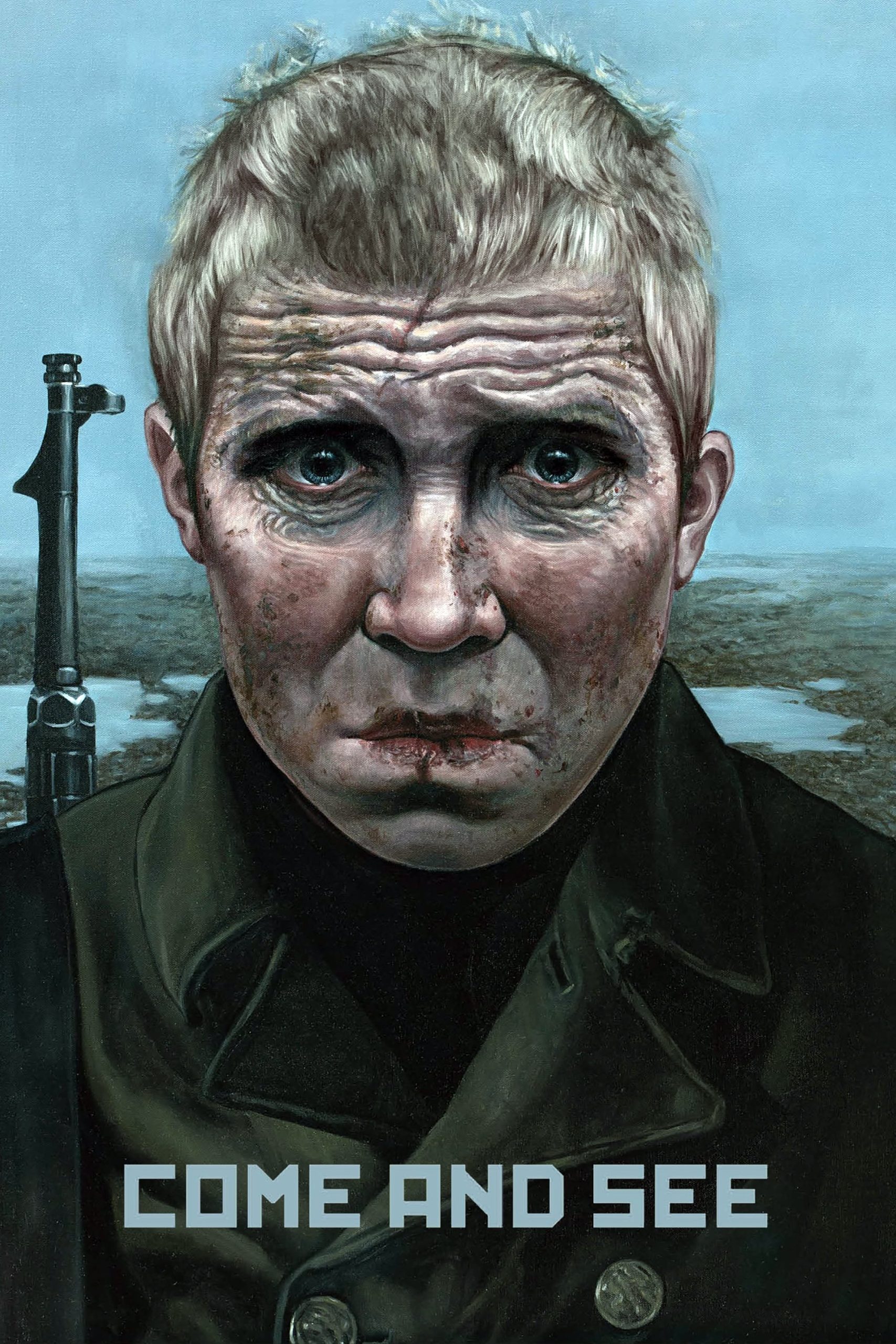
The Historical Landscape
Every time I revisit “Come and See,” I find myself plunged completely under the surface of Soviet history—more specifically, the quaking tremors of Eastern Europe in the mid-1980s. The very atmosphere of 1985, hovering just on the edge of seismic change within the Soviet Union, is somehow sealed within the film’s frames, as if the chaos outside the cinema doors had bled into the celluloid itself. For me, the mid-eighties were a palpable fever of tension and tentative hope—a crucible forged from decades of state censorship, Cold War paranoia, and the spectral memory of World War II’s endless devastation. This was the twilight moment before glasnost and perestroika became household words, before the Iron Curtain began to ripple with the wind of new possibilities.
I can still sense the cautious exhilaration of that era radiating beneath the surface. Leadership had finally shifted from the hardline silence of the Brezhnev years to Mikhail Gorbachev’s unprecedented openness, and the citizens of the USSR were only just beginning to glimpse the vulnerability of a system that seemed ironclad for generations. I like to imagine the streets of Minsk or Moscow, faintly humming with the early whispers of change—newspapers tentatively hinting at truths previously buried, citizens debating with a candor unknown to their parents. In a world crisscrossed by barbed wire and invisible walls, stories like “Come and See” could suddenly pierce the collective psyche in ways I doubt previous filmmakers could have imagined.
Yet, the timing of the film’s release always strikes me as meticulously poignant. In the West, the memory of World War II was already canonical, often recounted as a distant triumph or tragedy, but in the Soviet Union, the war loomed as a foundational trauma, its wounds nowhere near healed. By 1985, the grand mythos of the “Great Patriotic War” had calcified into official doctrine, celebrated relentlessly during annual victory parades yet rarely spoken about in brutally honest terms. Watching “Come and See” through the lens of its release year, I can almost taste the mixture of pride, exhaustion, and deep moral reckoning that characterized an era bracing itself for upheaval.
Cultural and Political Undercurrents
The landscape of Soviet society in the 1980s was defined as much by what could not be said as by what was openly expressed. As I contemplate the birth of “Come and See,” I feel the ever-present static of censorship buzzing in the background—a force so ingrained it threatened to suffocate honest discussion about the past. My impression is that Elem Klimov, the director, was operating in a world where memory was a contested terrain, and the government maintained a steely grip on which stories would flourish and which would wither in silence.
But even under the watchful eye of the censors, a powerful yearning for truth had begun to percolate. I see the film as a testament to the courage of artists pushing at the boundaries of what could be shown, risking professional and personal peril to excavate authentic pain. For most of the preceding decades, Soviet war films tended to sanitize horror, to render suffering noble or obscured by poetic grandeur. Yet, the 1980s brought a subtle but perceptible shift. Dissident voices—painters, writers, and filmmakers—had begun to trace the outlines of trauma that the official narrative refused to acknowledge. The winds of perestroika had not yet released their full strength, but in the small cracks where repression faltered, startling works like this one took root.
On a deeper level, I often wonder how the trauma of the previous generation—those who survived the war’s decimation of Belarus, whose forests became charnel houses—haunted the collective consciousness of the era. The children of survivors bore the residue of stories left unspoken, inheriting both pride and terror. This psychological inheritance bred an uneasy silence, which Klimov’s film detonates with a rare intimacy. As I see it, “Come and See” pulls back the veil not only on historic atrocities, but on the unresolved anguish festering within Soviet identity itself.
And then there was the world outside the USSR, quietly watching. By 1985, Cold War tensions still raged, but even Western analysts sensed that the grim tableau of the Eastern Bloc was beginning to fracture. I interpret the film as both inward-facing—directed at the soul of the Soviet people themselves—and outwardly communicative, a warning flare illuminating shared human suffering that defied the boundaries of ideology.
The Film as a Reflection of Its Time
When I immerse myself in “Come and See,” I recognize it as much more than a war movie. For me, the film possesses the power of a confession whispered after decades of silence, laced with all the guilt, horror, and longing for absolution that the epoch demanded. Every stylistic choice—its relentless pace, the hallucinatory viewpoint, the unsparing realism—reflects the psychological ferment of its time. I can’t separate its relentless honesty from the social reality that gave rise to it: a society unable to move forward without confronting its own buried trauma.
The 1980s in the USSR were a time of profound contradiction, rife with official optimism and private despair. What strikes me most is how Klimov refuses to render the war as heroic. I see his depiction of Belarusian partisans not as idealized martyrs, but as fractured, frightened human beings, scarred by losses too vast to name. Such truthfulness was rare. To me, the film’s unflinching violence doesn’t just catalog suffering; it forces the audience to internalize collective memory—so that, for a brief interval, every viewer becomes a witness, perhaps even a participant. I often feel this is what Klimov hoped for: to bridge the gulf between those who endured the war and those who inherited its wounds indirectly.
The aesthetic grit of “Come and See”—its overcast palette, the cacophony of sound, the obsessive focus on individual faces—strikes me as both a dialogue with and a condemnation of the sanitized propaganda of earlier years. In that sense, the movie is a double rebellion: against external enemies, and against internal forgetting. I find myself startled by the bravery required to confront, in such graphic and psychological terms, the mass killings perpetrated in Belarus. In 1985, to linger on the complicity and terror of ordinary people, to admit that survival often required randomness or collaboration, cut against the grain of every official statue and heroic mural. The film’s refusal to grant catharsis, its fixation on trauma that cannot easily be expiated, feels like the artistic embodiment of a society on the brink of dramatic self-revision.
As I interpret it, “Come and See” is responding à la minute to the epoch’s fractures and uncertainties. A sense of exhaustion pervades the faces and landscapes of the movie, mirroring the disillusionment held by millions confronting shortages, bureaucratic malaise, and the steady collapse of Stalinist mythologies. I often see in the film a kind of reckoning: with power, with history, with the tangled mess of memory and forgetting that became so central to late-Soviet life. For me, watching the film is less about receiving a history lesson than experiencing a communal act of mourning that could not have existed before the anxieties and aspirations of 1985.
What stands out in my mind is the way Klimov’s direction assaults the viewer’s senses with a rawness previously unseen in Soviet cinema. Every time Pyotr Masherov, the First Secretary of the Communist Party of Byelorussia, is referenced as having supported the film, I sense a high-wire act—permission gained, but danger close at hand. The film’s stamina endures as a meta-commentary on the era: a testament to what it meant to seek and speak truth in the midst of official repression and tentative liberalization.
Changing Perceptions Over Time
When I think back to the film’s initial reception, it’s almost impossible for me to imagine the shock that must have rippled through Soviet audiences. The era’s filmgoers had been primed for patriotic spectacle, not the merciless intimacy of Klimov’s lens. Yet from the very beginning, I suspect there was an underground resonance—a half-whispered acknowledgment that someone had finally said the unsayable. My own later encounters with the film have only deepened my sense that its meanings have multiplied with each passing year.
By the 1990s, as the Soviet Union dissolved and its history was exposed to sunlight, I noticed “Come and See” underwent a sort of metamorphosis. Where once it was a film about collective suffering, it soon became an emblem of the importance of memory itself. As secret NKVD archives began to open, as survivors of both the Holocaust and Stalinist purges found space to tell their stories, the film’s bleak vision was validated rather than undermined. I find myself repeatedly struck by the expansion of its audience; no longer confined to Soviet viewers, its shattering realism began to attract cinephiles, historians, and human rights advocates worldwide. The universality of its warning—that to ignore trauma is to guarantee its recurrence—gained new traction amid subsequent wars and genocides in Rwanda, Bosnia, and elsewhere.
In my experience, the more distance we put between ourselves and the events portrayed, the more acutely the film’s prescience is felt. I’ve encountered younger viewers, born decades after both the film’s release and the world it memorializes, who see its horror as both specific and chillingly contemporary. For them, as for me, “Come and See” stands as a bridge: a way to reach across the silence that separates generations and geographies, invoking compassion and vigilance. With each new atrocity that mars our world, I sense the film’s imagery echoing—reminding us that historic evil is neither distant nor inevitable, but the product of countless choices and omissions.
My perception of the film has evolved, too. What once felt relentlessly pessimistic now seems to me a beacon of tragic honesty. The film’s refusal to grant its characters or viewers a comforting narrative aligns neatly with the discomforting truths uncovered as Soviet society has reckoned with its own legacy. I have seen modern critics call the film out for its “emotional brutality,” but what strikes me is the compassion underlying every frame—the insistence that dignity persists, even amid dehumanization. The endurance of the film rests not in its ability to shock, but to ask its audience: what will you do with this inherited truth?
Historical Takeaway
For me, “Come and See” is perhaps the most haunting historical document to have emerged from late Soviet cinema. It is not a record of events per se, but an emotional exorcism—a striking testament to the epoch’s finally-broken silences. I have often argued that one cannot understand the era of the late Soviet Union without grappling with the film’s multifaceted revelations. It lays bare the dual inheritance of courage and complicity, and the desperate necessity of remembering even the most unspeakable pasts. More than a warning or a lament, I see in Klimov’s work a profound act of moral resistance that defines the best (and sometimes the rarest) offerings of late Soviet art.
As I reflect on the Soviet society that produced the film—a society burdened by myth, wracked with suppressed trauma, and inching toward reform—I find myself continually returning to the insight that true historical reckoning requires both courage and communion. The film’s impact on me comes from its relentless refusal to allow me the comfort of distance; it positions me as both witness and participant, reminding me that the act of remembering is neither passive nor safe.
Ultimately, “Come and See” reveals the fragility and power of memory within an era caught between erasure and revelation. The year 1985 becomes, in my mind, not just a turning point in Soviet history, but a proving ground for what art could accomplish when historical honesty is finally permitted—at great cost—to seep into public consciousness. The film is a plea and a promise. If I heed its lessons, I am compelled to recognize my complicity in both denial and remembrance, tasked perhaps, as all viewers are, with carrying something of the film’s warning into whatever era I happen to inhabit.
To see how these real-world elements shaped the film’s impact, you may also explore its reception and legacy.
🎬 Check out today's best-selling movies on Amazon!
View Deals on Amazon