
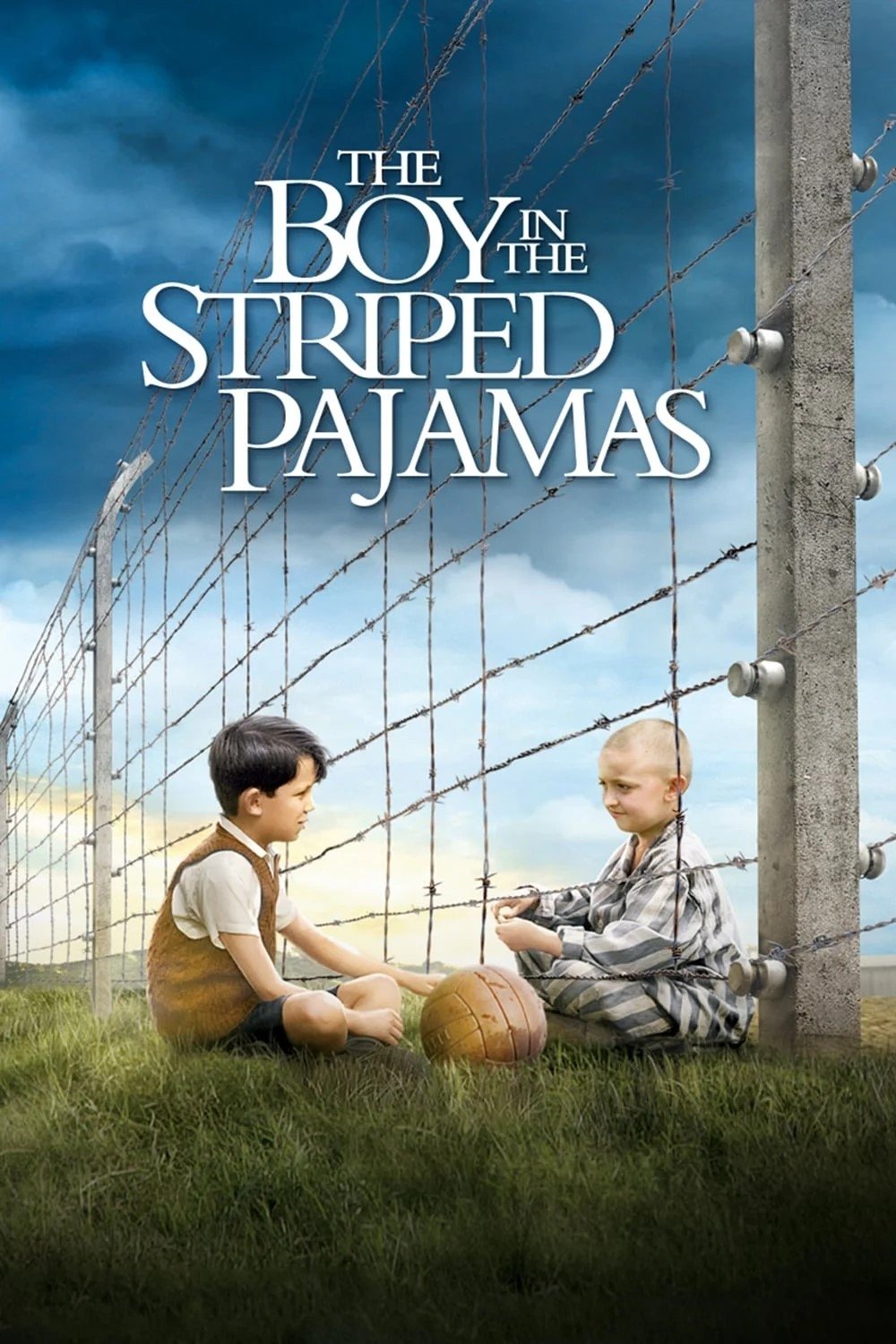
The Historical Era of the Film
Looking back at my first experience with Boy in the Striped Pyjamas (2008), I found myself constantly weighing the magnitude of the era it sought to portray against the one in which it was crafted. Before immersing myself in the film’s world, I always remind myself that the Holocaust—one of the most systematically destructive events of the twentieth century—serves as its grim backdrop. I see the 1940s as more than a simple point in time; for me, it’s a chilling demonstration of what unchecked power, extreme ideology, and propaganda are capable of producing. The policies of Nazi Germany, driven by totalitarianism and fueled by a racially charged nationalist fervor, led to the persecution and murder of millions, including approximately six million Jews. These circumstances inevitably underpin every artistic choice present in the film.
When I consider the economic landscape of wartime Europe, the words “deprivation” and “desperation” come to mind. Civilian populations endured unprecedented rationing, displacement, and trauma. Families were ruptured. For those outside Germany, the war’s reach triggered fear, patriotism, or sometimes, willful ignorance. I find the social fabric of the time both fragile and charged with dangerous conformity. The German citizenry, in particular, was caught in a web of indoctrination and surveillance, persuaded to either support the regime or remain silent. To me, this is not a distant history—it’s a vital context that shadows every frame of a historical drama set during this period.
Moving ahead in time, I acknowledge that Boy in the Striped Pyjamas (2008) was released over sixty years after World War II ended. The meaning of “historical context” here becomes twofold: the film portrays a time long gone, and yet, it is filtered through a contemporary lens. I remember the mid-2000s as a period of both remembrance and debate regarding World War II. Museums, survivors, and educational curricula were all engaged in vigorous conversation about how the Holocaust should be depicted, discussed, or memorialized. In my view, this post-millennial era was deeply reflective, aware that the last living witnesses were aging out of public life.
For anyone interested in film history as I am, it’s impossible to ignore the advances in visual storytelling and digital technology during the 2000s. Directors and producers suddenly had the tools to create historically authentic worlds in ways never before possible. Yet, for all the power of special effects, filmmakers still faced the philosophical question of how to honor history truthfully. That tension between technical possibility and ethical responsibility seemed, to me, embedded in the cautious way the film chooses its visual palette, narrative structure, and even its silences.
Social and Cultural Climate
When I reflect on the social climate in which Boy in the Striped Pyjamas was made, I think of a broader era of reckoning with the past. The early 2000s in Europe and North America witnessed increased sensitivity to questions of memory, trauma, and national identity. There was a profound preoccupation with Holocaust education, especially given rising concerns over Holocaust denial and revisionist history creeping into public discourse. As someone who has spent countless hours poring over news archives from that decade, I recall public initiatives aimed at countering ignorance and combating anti-Semitism, making the period a fertile—albeit fraught—setting for such a film’s creation.
I noticed fierce debates within academic and popular culture circles about how Holocaust narratives should be told—whether through untold survivor stories, graphic documentary realism, or, controversially, through fictional accounts featuring children or outsiders. I was particularly struck by the tension between respectful solemnity and the necessity to humanize the incomprehensible scale of tragedy through accessible, relatable stories. Filmmakers, authors, and educators seemed to walk a tightrope during these years, ever-mindful of public scrutiny. To me, Boy in the Striped Pyjamas is a product of that very milieu: a society eager to engage younger generations with history in ways that would evoke both empathy and discomfort.
In this age, what I found fascinating was the emergence of new cultural narratives addressing the lingering wounds of the past. I remember the prevalence of televised interviews with survivors, televised documentaries, and major international commemorations such as Holocaust Memorial Day. These events shaped the broader dialogue on how history’s most painful episodes should be represented in art and media. It was a time of both nostalgia and renewed confrontation with uncomfortable truths, as well as skepticism toward simplistic or sentimental treatments of complex histories.
Notably, this was also a period during which global migration and integration brought renewed focus to topics of tolerance, “otherness,” and the dangers of hate. I saw many artists—including filmmakers—using the Holocaust as an allegorical reference point for contemporary issues, from xenophobia to the defense of human rights. In this social context, the release of Boy in the Striped Pyjamas represented not only a historical dramatization, but also, for me, a commentary on the importance of seeing the humanity behind ideological walls, no matter how controversial the framing might be.
How the Era Influenced the Film
While watching Boy in the Striped Pyjamas, I often find myself considering how deeply its narrative and aesthetic vision are shaped by both the era it depicts and the era in which it was made. The choice to center the story on a child’s perspective—specifically, that of an eight-year-old German boy—did not occur in a vacuum. In my view, this reflects a late twentieth and early twenty-first century tradition in literature and film of exploring traumatic historical events through the eyes of the innocent. I see this as a means of enlarging the film’s potential audience, appealing to universal themes of childhood, innocence, and lost illusions, while simultaneously foregrounding the horrors of dehumanization and complicity.
The early 2000s filmmaking context, shaped as it was by global conversations around memory and testimony, clearly steered production choices toward intimacy rather than spectacle. I’ve observed that the film’s restraint—its quiet interiors, limited use of graphic violence, and emphasis on small, everyday details—mirrors a broader resistance to desensitizing audiences through sensationalism. This aligns, to my mind, with contemporary educational priorities that favored encouraging reflection over evoking shock and awe. Such choices tell me a great deal about the director’s sensibility and his sensitivity to an audience that might otherwise turn away from an overtly brutalist approach.
Examining the specifics of the film’s production, I can’t ignore the influence of ongoing public discourse. As I dug into interviews and behind-the-scenes materials, it became clear to me that the filmmakers felt a responsibility to avoid both trivialization and voyeurism. I heard echoes of the decade’s anxieties about historical authenticity: set designs and costumes underwent meticulous research, and narrative arcs were subjected to careful scrutiny by consultants. Even the decision to adapt John Boyne’s 2006 novel for the screen, with its emphasis on the perspective of children on either side of the camp fence, feels symptomatic to me of the era’s impulse to personalize tragedy without losing sight of its larger ethical implications.
Among the most significant historical pressures shaping the film, I’d single out these key factors:
- The persistence of Holocaust memorialization and education initiatives
- Ongoing public debates about how to represent the trauma of genocide in art
- Heightened awareness of rising anti-Semitism and revisionism
- Technological advances in filmmaking that allowed for immersive historical re-creation
I’ve always thought that these considerations do not constrain the creative imagination, but instead compel it toward a specific kind of responsibility—one that is keenly aware of the power, and also the peril, of reinterpreting living memory for a new generation.
Audience and Critical Response at the Time
As someone who followed the contemporary response to Boy in the Striped Pyjamas quite closely, I remember a palpable sense of anticipation and apprehension leading up to its release. The film’s arrival came at a moment when the cinematic landscape was saturated with Holocaust representations, from haunting documentaries to epic historical dramas. For a significant segment of the audience, the film’s less conventional approach—quiet, domestic, and child-centered—was both refreshing and deeply unsettling. I recall that many viewers were initially struck by the film’s ability to access the emotional truths of the Holocaust without recourse to graphic horror. This, to me, brought forth discussions about whether restraint was a strength or a form of evasion.
Critical reaction, as I witnessed and documented it, was marked by division. Some reviewers praised the film for its courage in depicting innocence corrupted by ideology. Others, particularly historians and survivors’ groups, objected to the risks of ahistoricism and oversimplification. In my work, I frequently returned to those reviews that criticized the film for placing narrative empathy with a German child, which they felt might distort or minimize the Jewish experience of the Holocaust. I saw this as part of a broader cultural debate in the mid-2000s about whose stories should stand at the center of Holocaust memory, and what creative risks are permissible in the process.
Perhaps most fascinating to me was the film’s reception among educators and parents. Boy in the Striped Pyjamas, in my view, quickly entered the canon of teaching tools in secondary classrooms. This was not without controversy. While many teachers applauded its accessible narrative as a means of sparking conversation among youth, others feared it might inadvertently reinforce misconceptions or historical inaccuracies. I believe this split response underscores the evolving relationship between art and pedagogy during this era: a desire to engage emotively with the past, even at the risk of misinterpretation.
For general audiences—those outside the orbit of Holocaust scholars and activists—the film prompted a surge of online discussions and book sales. I recall heated debates in online forums and newspapers about the responsibilities of artists, the ethics of representing genocide, and the lingering imperative to “never forget.” In my experience, the combination of emotional accessibility and historical controversy guaranteed that the film would not simply fade into obscurity.
Why Historical Context Matters Today
Whenever I revisit Boy in the Striped Pyjamas or discuss it with students and fellow historians, I find myself returning to the question of historical context. To me, understanding the social and political forces that shaped both the film’s setting and its production is essential—not just for appreciating the story, but for evaluating its impact and legacy. It’s only by grasping the anxieties, memorial practices, and technological advances of the early 2000s that I can fully apprehend why the film looks and feels the way it does, and what risks it takes in communicating its subject to contemporary audiences.
I am convinced that historical context acts as both a lens and a filter. It enables me to see that the filmmakers were negotiating not simply with the past, but with the present—its uncertainties, its wounds, its aspirations for truth and dialogue. The pressures of Holocaust education, the responsibilities of representation, and the constant specter of misappropriation or trivialization weigh heavily on works like Boy in the Striped Pyjamas. For me, recognizing these constraints and influences does not diminish aesthetic pleasure or emotional engagement; rather, it deepens my respect for the audacity and difficulty of such creative undertakings.
One of the most profound lessons I take away from historical context is its capacity to illuminate why certain stories are told at certain times, and for whom. In an age marked by the decline of living witnesses and rising disinformation, films like this become, for me, both cultural flashpoints and pedagogical tools. They prompt questions, discussions, and sometimes, heated disagreements—each of which contributes to the ongoing process of historical understanding. As I see it, critical engagement with these films reminds societies—mine included—that memory is not a passive inheritance, but an active project shaped by urgent questions of identity, responsibility, and justice.
Ultimately, every time I engage with Boy in the Striped Pyjamas (2008), I become acutely aware of the dangers and promises of representing trauma in popular media. By situating the film in its proper historical context, I can better discern its unique contributions and its limitations—what it reveals, what it distorts, and how it continues to shape collective remembrance for new generations.
After understanding the factual background, you may want to see how this story was received as a film.
🎬 Check out today's best-selling movies on Amazon!
View Deals on Amazon