
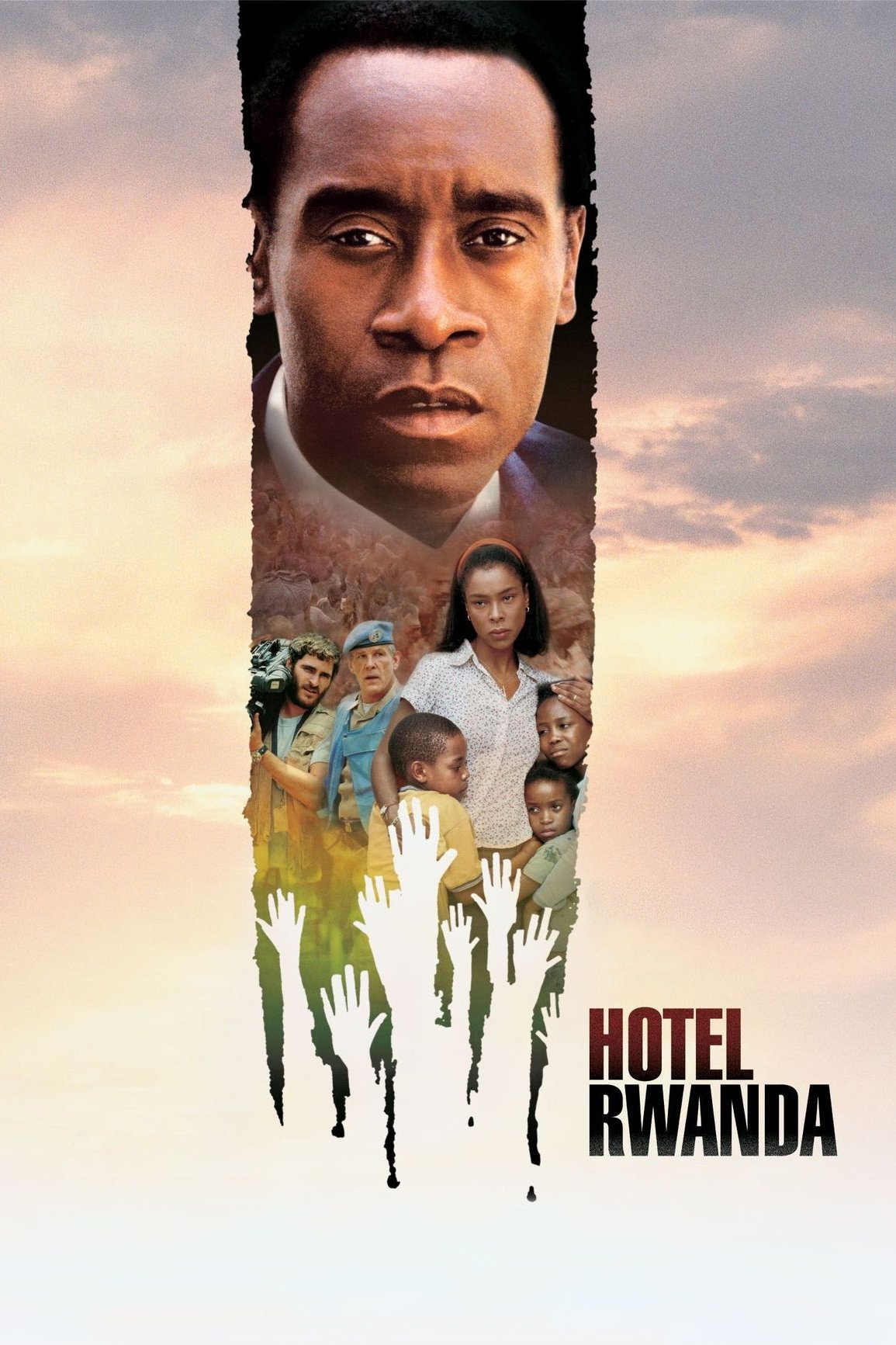
The Historical Era of the Film
Whenever I sit down to think about Hotel Rwanda (2004), I can’t help but feel the immense weight of the period portrayed and the era in which the film was produced. As a professional film historian, my frame of reference always begins with the mid-1990s—when the actual events occurred—juxtaposed against the early 2000s, when the world finally seemed willing to look back and reckon with what had happened in Rwanda. The Rwandan genocide of 1994 stands as one of humanity’s most horrific failures, exposing the extreme consequences of ethnically motivated violence, political instability, and international inaction.
The political conditions at the time were deeply fractured. Rwanda, in the years leading up to the genocide, was a nation deeply scarred by colonial legacies. The Belgian colonial power’s policy of ethnic classification created lasting rifts between the Hutu majority and Tutsi minority, institutionalizing differences that had long been more fluid. In the early 1990s, the country navigated a tense ceasefire after years of civil war between the Hutu-led government and the Rwandan Patriotic Front, a predominantly Tutsi rebel group. When the plane carrying President Juvenal Habyarimana was shot down on April 6, 1994, it unleashed a wave of orchestrated violence that left an estimated 800,000 people dead in just over three months. I remember thinking that the sheer speed and ruthlessness of this period was almost unfathomable.
Economically, Rwanda was desperately poor. Years of civil strife and repression had left its economy in tatters, and the country’s already limited infrastructure buckled under the strain of war. Hunger, unemployment, and uncertainty were widespread—factors that fueled the sense of hopelessness and anger among the population. Internationally, the response was shamefully inadequate: the United Nations drastically reduced its peacekeeping mission just as the killing intensified.
By the early 2000s, when the film was brought to life, the world had entered a different chapter. In the post-9/11 era, global headlines were dominated by new conflicts and security crises, but there was also a growing sense of collective guilt about the inertia of the 1990s. Different nations had begun, uneasily, to reckon with their own roles in historical atrocities, and public conversation about humanitarian intervention was shifting. Transitional justice, as tackled by the International Criminal Tribunal for Rwanda, was creating new legal standards for prosecuting crimes against humanity. This shift in the political and legal climate profoundly shaped what would be possible to depict, discuss, or even acknowledge in a mainstream film about Rwanda.
- The legacy of colonial rule and ethnic classification
- Ongoing impacts of civil war and political instability
- Severe economic hardship and social breakdown
- International indifference and minimal intervention
What struck me, reflecting on Hotel Rwanda’s production era, was how the world in 2004 was hungry for films that would stare directly at uncomfortable truths about recent history. The early 2000s, for all their anxieties, were marked by renewed internationalism and attempts to confront the legacies of inaction. That made this period a uniquely potent historical context for the creation and reception of this film.
Social and Cultural Climate
When I analyze Hotel Rwanda, I am always drawn to the social and cultural forces swirling around both Rwanda in 1994 and the world a decade later. In the months leading up to the genocide, Rwanda’s social climate was poisoned by relentless propaganda from state media, especially the notorious Radio Télévision Libre des Mille Collines (RTLM). This radio station, which broadcast hateful rhetoric around the clock, deepened pre-existing ethnic suspicions and turned ordinary people into participants. What began as a country trying to accommodate social differences became a tinderbox stoked by years of resentment, fear, and the persistence of stark social divides.
On a cultural level, I have always felt that Hotel Rwanda dares to ask Western audiences to confront not just the raw facts of genocide, but the cultural tensions that made global inaction possible. In 2004, conversations about race, responsibility, and humanitarianism were gaining renewed relevance. Hollywood was slowly reckoning with its own limited and frequently superficial representations of African stories. Popular culture, for too long, seemed to either ignore African tragedies or strip them of their specific details, painting the continent with a broad, patronizing brush. The emergence of films like Hotel Rwanda, and the conversations that followed, signified a significant, if hesitant, step towards more authentic and unflinching storytelling.
The cultural climate in the production era was also marked by a growing emphasis on global awareness. There was an upswing in international human rights advocacy, and documentaries, non-governmental organizations, and cross-cultural collaborations were increasingly visible in public discourse. Yet, I could sense an undercurrent of discomfort. Many of my peers in the film and academic worlds felt uneasy about confronting the failures of powerful countries and international organizations, preferring instead to focus on individual stories or heroic narratives. Hotel Rwanda’s focus on the character of Paul Rusesabagina, an ordinary hotel manager, fit this trend perfectly: it allowed audiences to engage emotionally with a character rooted in real, local experience, yet at the same time provided a culturally digestible entry point for viewers who may have been unfamiliar with the complexity of Rwandan society.
In summary, the social and cultural context that shaped Hotel Rwanda and its reception included:
- Widespread ethnic tensions exacerbated by propaganda
- The influence of international perceptions of Africa
- Increasing attention to global humanitarian issues in media and public discourse
Above all, I found the film’s social climate reflected not just in the story it tells, but in how it was told—a narrative striving to bridge cultures, confront denial, and encourage empathy in an era that was beginning to look outward, even if still hesitantly.
How the Era Influenced the Film
When I consider how the era influenced Hotel Rwanda, it’s clear to me that both the tumult of the 1990s and the reflective early 2000s exercised a powerful grip on the film’s storytelling choices, character focus, and even its production logistics. The real-world events upon which the film is based—the genocide, international indifference, and small acts of resistance—are at the heart of what I interpret as an urgent call to remember. Yet the decision to center the story on Paul Rusesabagina and his family instead of focusing exclusively on mass suffering is a distinct reflection of how Western cinema, in the early 2000s, sought to humanize, not just dramatize, atrocities.
By drawing on the specific economic and political threads of 1994 Rwanda, the filmmakers were able to ground Hotel Rwanda in a world of scarcity and fear. The UN’s withdrawal—a moment that left Rusesabagina and others essentially abandoned—appears to me as both a critique and a document of how political realities shape personal destinies. The film’s production team, facing questions about accuracy and representation, had to navigate not just the sensitivities of survivors and local populations, but also the expectations of an international audience accustomed to more sanitized or simplistic depictions of African history. Filming took place in South Africa, a practical choice reflecting both safety concerns and the budding South African film industry made possible by the end of apartheid. This is a fact I often mention when speaking about how global film economics interact with history.
I believe the early 2000s zeitgeist also shaped the film’s tone and pacing. The rise in awareness about human rights abuses across the globe meant the film could now depict, with a certain directness, the bureaucratic failures and moral ambiguities that had defined international engagement with Rwanda in 1994. I personally noticed echoes of post-September 11 anxieties in the film’s depiction of bystander inaction, the thin line between safety and chaos, and the pressing need for moral clarity.
When I look at the film’s reception and the decisions made during production, I see a deep tension—the desire to memorialize the dead and assert the dignity of survivors, while also creating a film that could catalyze discussion in a world trying not to repeat the same mistakes. The historical context, here, was not just a backdrop; it was an active force shaping every scene, every casting decision, and every narrative choice.
Audience and Critical Response at the Time
Reflecting on the social and critical reception to Hotel Rwanda’s release, I remember vividly how the movie landed like a wake-up call for many. Audiences—especially in North America and Europe—were shocked by their own ignorance of the Rwandan tragedy. Having spent years participating in film festivals and public discussions, I saw firsthand the impact a film like this had, especially in societies where the events in Rwanda had either been ignored or consigned to brief news flashes in 1994. The depiction of such brutal recent history, paired with the moral complexity of bystanders and perpetrators, struck a chord with viewers seeking to understand their own place in a world marked by distant violence.
Critics at the time responded with a mixture of admiration and unease. On one hand, many were relieved to see a film seriously attempt to deal with Africa’s modern history without resorting to the usual clichés or romanticizing Western intervention. On the other, there was discomfort about the realities the film exposed. For audiences and critics alike, Hotel Rwanda became an occasion for reflection—both on cinematic responsibility and on the legacy of inaction in humanitarian crises.
I recall seeing heated debates in academic settings and mainstream publications: Had the film captured enough context? Was it too “Hollywood” in its focus on one hero, or did it do justice to the many voices that went unheard? In Rwanda itself and throughout the African diaspora, reactions were particularly complex. Survivors and witnesses, in some cases, questioned not the accuracy but the emotional honesty of the film—did it provide catharsis, or did it re-open wounds that the world had refused to help heal?
Despite these debates, what resonates with me even now is how Hotel Rwanda forced open conversations about moral complicity and the failures of international actors—subjects too rarely discussed, even in films that claim to confront global injustice. The strong performances and restrained style prevented it, in my personal view, from descending into exploitation, and, for many, it functioned as both a learning tool and a challenge to complacency.
Why Historical Context Matters Today
Whenever someone asks me why historical context is crucial for appreciating films like Hotel Rwanda, I can’t help but insist that, for this movie in particular, understanding its roots is the difference between fleeting sympathy and deep engagement. The historical context exposes the intricate ways that colonial divisions, post-Cold War politics, and modern humanitarian dilemmas collide to produce tragedies that are never inevitable, and always the product of specific choices. When I teach or write about Hotel Rwanda, I’m reminded how quickly even the most shocking headlines fade, unless works of art push us to dig deeper into the causes and consequences of these events.
Knowing the historical context allows me to see the film’s nuanced critique of international bureaucracy and the dangers of indifference. The story resonates not just as a tale of individual courage, but as a warning about how fear, propaganda, and cynical diplomacy can isolate people during their darkest hours. Too often, contemporary viewers—myself included—are tempted to judge, mythologize, or distance ourselves from these narratives. Understanding the social and political climate of Rwanda in 1994, and the anxieties of a post-9/11 world in which the film was created, reframes the movie as both memorial and urgent lesson.
For me, rewatching Hotel Rwanda in our current era, when new humanitarian crises rise and the old mistakes threaten to repeat, the importance of context is even more pronounced. The film becomes a living document, a conversation across generations about the responsibilities of witness, the subtle machinery of atrocity, and the power—and limitations—of global awareness. My appreciation deepens each time I return to it, because I understand not just what it shows, but why it was made, and what it asks of its audience beyond the credits.
After understanding the factual background, you may want to see how this story was received as a film.
🎬 Check out today's best-selling movies on Amazon!
View Deals on Amazon