
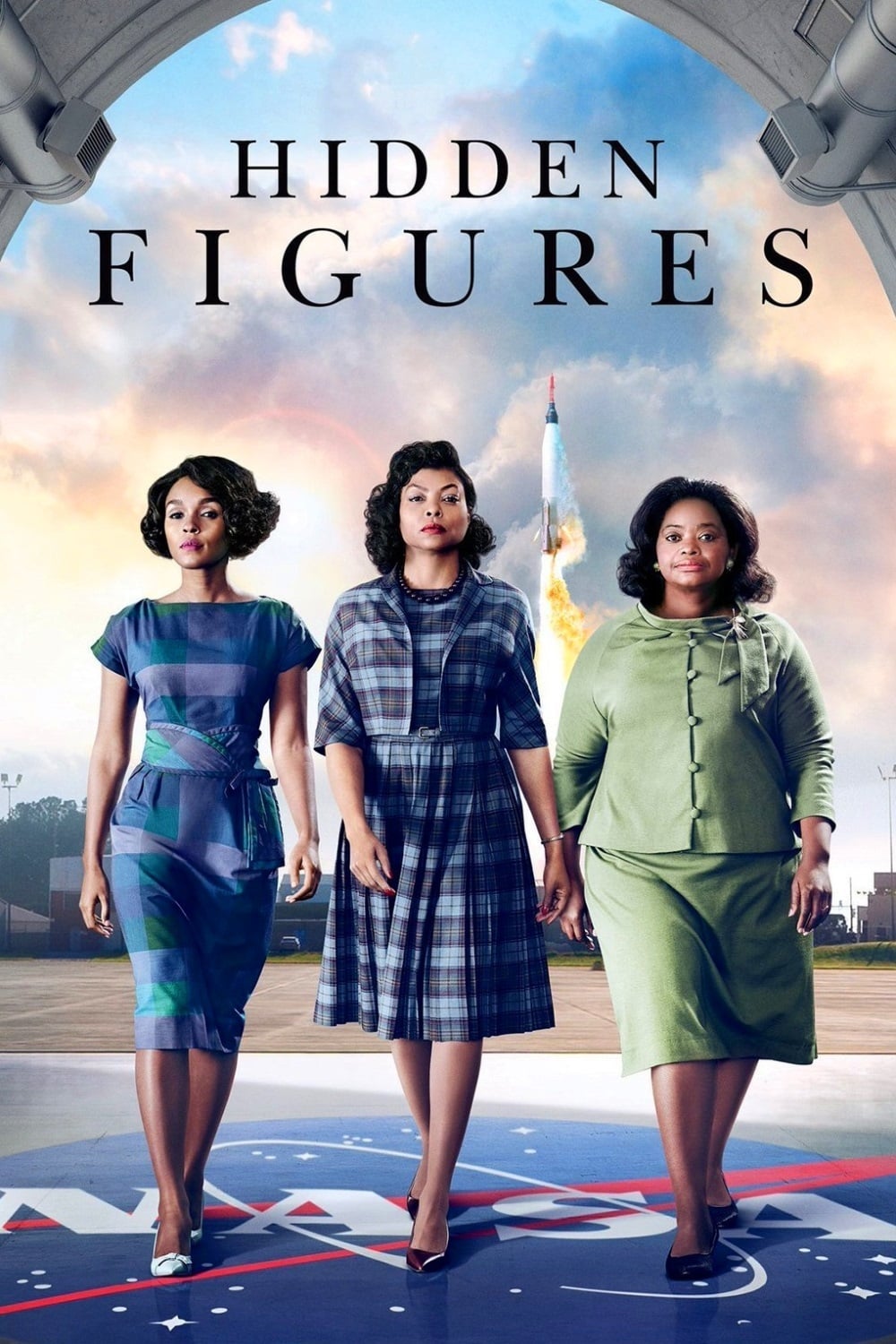
The Historical Era of the Film
Every time I revisit Hidden Figures (2016), I am reminded of how starkly the era’s political, economic, and social landscape shaped its story. When I first encountered both the real historical figures and their cinematic counterparts, what struck me most was that they are anchored in a very specific moment: early 1960s America, a time vibrating with tension and change. The political climate was dominated by the Cold War, with the United States in a technological sprint against the Soviet Union, each superpower vying for supremacy in space as a demonstration of national strength. That race—punctuated by the launch of Sputnik and the relentless drive to send a man to the moon—created an atmosphere where scientific achievement became synonymous with patriotism, but also exposed fissures within American society.
What is particularly vivid to me is how the economic boom following World War II did not yield prosperity evenly. While certain sectors found unprecedented opportunities, especially those in science and technology, entrenched racial barriers prevented many Americans from partaking fully in these advances. Policies like segregation and discriminatory hiring defined the labor market, particularly in states such as Virginia, where the Langley Research Center was located. I often reflect on how, for African American women especially, economic access was a battle fought on multiple fronts.
On a social level, I find the push for civil rights during this period impossible to ignore. As someone who has studied the era, the cadence of the freedom marches, the bravery of activists in the face of Jim Crow laws, and the everyday struggle for dignity echo throughout the film’s depiction of workplace life. Strong currents of institutional racism and sexism dictated the bureaucratic world at NASA, and the everyday indignities faced by African Americans were not only tolerated, but woven into the fabric of public life. To me, the juxtaposition of the era’s technological optimism with its social repression is one of the film’s most haunting undercurrents.
Social and Cultural Climate
Hidden Figures tells a story directly shaped by the dominant social attitudes and prevailing cultural tensions of its era—a dimension that always impacts me deeply as a viewer and historian. The United States in the early 1960s was in the throes of segregation, entrenched by decades of Jim Crow laws and shaped by deeply ingrained prejudices around race and gender. In nearly every facet of life—schooling, housing, transportation, even restroom access—the doctrine of “separate but equal” created tangible barriers that, to this day, remain difficult for me to fully comprehend outside of scholarship and period accounts.
When I think about the cultural climate portrayed in Hidden Figures, I notice how these structures of racial and gender hierarchy were not just legal but social conventions. It was an era where the very presence of African American women in a scientific workplace was rare, if not outright shocking to many. Their roles were circumscribed, their ambitions constrained, and their contributions all too often erased from public memory. I find it essential to underline that these were not simply personal experiences, but the norm for many across the South and much of the United States, influencing daily interactions and professional opportunities for a significant proportion of the population.
The context of the space race further complicates this picture. The glorification of American ingenuity and technological progress was pervasive, yet popular culture and mainstream media almost always featured white male engineers, astronauts, and scientists as representatives of this pursuit. Hidden Figures subverts this by centering figures traditionally overlooked by history. From my readings and conversations, I also know how popular media and state propaganda both reflected and reinforced gender roles, framing women’s contributions as support roles—mathematics and computation, though vital, were rarely shown as central to technological breakthroughs. Such trends resonate with what I see in the film’s portrayal of the characters’ professional isolation.
Some of the key historical factors that frame this social and cultural climate include:
- Legalized racial segregation through Jim Crow laws
- Restrictive gender norms limiting women’s access to STEM fields
- The symbolic and competitive fervor of the Cold War space race
- The slow, ongoing momentum of the modern civil rights movement
For me, the film serves as a window into a world bifurcated by prejudice and yet poised on the cusp of transformation. By evoking both the details of social exclusion and the seeds of change, the cultural backdrop feels alive and urgent in every scene.
How the Era Influenced the Film
I am consistently struck by how the historical circumstances of the early 1960s directly shaped every element of Hidden Figures, from the characters’ personal struggles to choices made in production. In my analysis, the climate of state-sanctioned segregation and the persistent marginalization of African Americans and women aren’t just background details—they are the story’s engine and its most persistent antagonist. The meticulous recreation of NASA’s segregated offices, the costuming, and set decor all evoke the era’s insistence on visible boundaries and invisible glass ceilings.
When I watch the film, I see how the era’s limitations forced its subjects—Katherine Johnson, Dorothy Vaughan, and Mary Jackson—to innovate not only for the sake of their work, but also for their very presence in the workplace. The bureaucratic obstacles, coded dress codes, and the hesitancy of colleagues reflect that prevailing suspicion of “difference” in technical settings, a fact I’ve encountered repeatedly in oral histories and archival research from the period. Yet, because of the enormous pressure cooker of the space race, those in power at NASA were compelled to prioritize results—sometimes, though reluctantly, over orthodoxy. That paradox fascinates me: institutional exclusion on the one hand, extraordinary necessity on the other, creating an environment where marginalized talent could just barely crack institutional walls.
Even in the film’s pacing and tone, I feel the tension that defined the era—urgency and hesitation, confidence and reticence. The dialogue often mirrors the clipped, formal cadence of government and scientific workplaces of the period, while the visual motif of barriers (from bathroom signs to closed-door meetings) reinforces the everyday realities of segregation. That the filmmakers chose to foreground these physical and symbolic barriers, rather than just focusing on technical achievements, is for me a deliberate invocation of the past’s restrictive energy.
Behind the camera, I also see the shadows cast by more recent history. The film emerged amid growing public interest in “unsung heroes” and broader conversations on diversity in STEM and Hollywood alike, yet it grounds its narrative very specifically in the lived realities of the 1960s. In the context of the production era, I believe there was a renewed willingness to question previously accepted narratives and to give screen time to those whose labor powered iconic moments but who never held the spotlight. The historical influence runs both ways: the film’s creation was informed by its era, while its release was anticipated by a social climate more open to revisiting and revising the contours of collective memory.
For me, Hidden Figures stands as a careful reconstruction—not just of events, but of feeling: the grind of institutional resistance and the fleeting exhilaration when boundaries are momentarily, or permanently, overcome.
Audience and Critical Response at the Time
Reflecting on the contemporary reaction to Hidden Figures, I am often moved by how important timing can be to a film’s reception. When the film debuted to American audiences in 2016, it tapped directly into widespread conversations about representation in media, the visibility of Black Americans in STEM, and the persistent, daily realities of systemic racism and sexism. This was a moment when American society was deeply engaged in discussions around equity and historical redress, and so the story’s resonance felt immediate and personal to many people I spoke with, as well as to me.
Critics largely greeted the film with strong approval, often praising its ability to combine the urgent historical specificity of the early 1960s with a hopeful, accessible narrative. I recall critics and historians alike expressing admiration for the nuanced portrayals of Katherine Johnson, Mary Jackson, and Dorothy Vaughan, personalities previously little known beyond academic and NASA circles. There was a clear sense of surprise—I would even say relief—that a major studio picture would so directly address issues of racial and gender exclusion not as peripheral challenges, but as central conflicts within a workplace otherwise painted as progressive.
Among general audiences, the reception was both emotional and energizing. The story seemed to encourage viewers to reconsider the complexities of American heroism and the hidden scaffolding beneath historic triumphs. In discussions I witnessed both online and in academic conferences, many people voiced how deeply the film connected with their own experiences of marginalization, but also with an enduring hope in the possibility of institutional change. In particular, African American women and those in scientific fields emphasized how rarely their histories were treated with such care and centrality.
Of course, as with any depiction of real events, there were critics who debated the film’s choices in dramatization. Some challenged what they saw as the “Hollywoodization” of struggle, or wrestled with questions about fidelity to the complex, sometimes ugly truths of institutional racism. But, as I experienced, these debates were framed within a wider appreciation for the film’s ambition and its rare centering of African American women as architects of historical progress.
Why Historical Context Matters Today
I have come to believe that grasping the historical context of Hidden Figures is central not just to understanding the film, but to honoring the lives it depicts. When I revisit the film in today’s climate, with continued debates over the legacy of racism and the role of women in science and technology, I realize how urgent these questions remain. The past the film evokes is not some distant, settled territory, but a living inheritance that continues to influence institutions and imaginations.
For me as a film historian, seeing the film through the lens of its original era transforms each scene into a document of social and cultural reality. The indignities suffered and small victories won by the characters are not simply narrative devices. They are reminders of the long, ongoing struggle to expand access, recognition, and dignity for all. The more I reflect on the significance of segregation, the necessity for perseverance amidst systemic exclusion, or the costs of erasure from public memory, the clearer it becomes how the film’s impact depends on acknowledging its roots in real, lived experience.
That context is not only historical but present. Conversations that have grown more urgent since the film’s release—around equity in STEM and the power of inclusive storytelling—gain new depth and force from the film’s honest engagement with the past. I notice that younger viewers, especially those exploring STEM fields or wrestling with issues of exclusion in their own lives, see in the film a reflection of ongoing realities. For me, this makes it less a period piece than a living conversation partner—a work shaped by, and still shaping, the public’s understanding of history and its implications for the present.
By taking time to understand the political and social climate of Hidden Figures’ setting and its production, I find myself equipped not just to appreciate cinematic craft, but to engage more honestly and compassionately with the unfinished work of justice and historical acknowledgment. It is a film rooted in one era, yet made vital by each new viewer willing to grapple with the world as it was—and still is.
After understanding the factual background, you may want to see how this story was received as a film.
🎬 Check out today's best-selling movies on Amazon!
View Deals on Amazon