
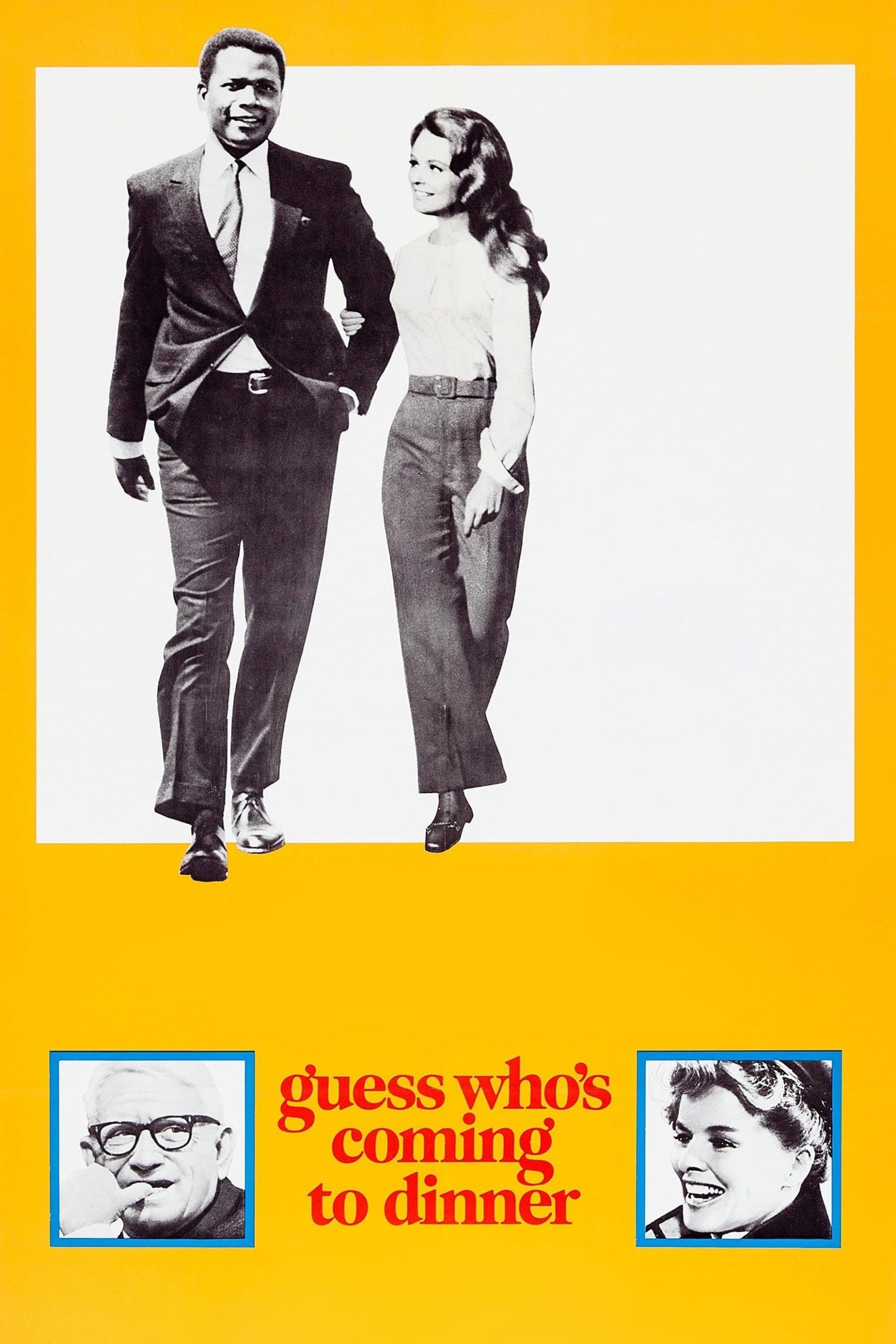
The Historical Landscape
Every time I revisit “Guess Who’s Coming to Dinner,” I’m immediately transported to a year unlike any other: 1967. I can almost feel the tension humming below everyday life—a raw, insistent energy shaping the choices people made. It was the summer of the first Super Bowl, the year Thurgood Marshall became the first Black Supreme Court Justice, and race riots flared in Detroit and Newark. The optimism of Camelot had faded into something harsher and more urgent; Martin Luther King Jr. was still with us, but he was increasingly lonely on the mountaintop. Watching this film, I’m overwhelmed by how deeply it draws from the chaotic palette of that period—a nation tilting between hope and crisis, between the promise of the Civil Rights movement and the stubborn persistence of old prejudices.
For me, the film is more than entertainment; it’s a window into a country pushed to reckon with its own ideals. While the Beatles were reinventing music and young people flocked to San Francisco for the “Summer of Love,” other Americans clung fiercely to the status quo. Television coverage—something so omnipresent now, but then so novel—brought images of marches, fire hoses, and police dogs into living rooms that just a decade earlier had been insulated by custom and geography. Against this backdrop, the appearance of a film that could openly, almost cheerfully, tackle the idea of an interracial marriage felt to me like a small, mainstream revolution. The country was shifting, sometimes violently, but few moments in popular culture acknowledged the everyday impact of those seismic changes.
What stands out in my mind is that 1967 wasn’t just about conflict; it was also about impossible hope. Loving v. Virginia, that landmark Supreme Court decision declaring anti-miscegenation laws unconstitutional, coincided almost magically with the film’s production. Yet I sense that when people sat down in theaters—or, more likely, in living rooms later—they brought more than a casual interest in the movie’s outcome. They arrived with anxieties: about their neighbors, about their children, about what would happen if the boundaries that had ordered life for centuries were suddenly, irreversibly changed. The historical landscape was jagged and tender, as jagged and tender as the conversations that underpin the film.
Cultural and Political Undercurrents
Whenever I reflect on the subtext swirling beneath “Guess Who’s Coming to Dinner,” I’m struck by how much it owes to the undercurrents roiling through American society at that very hour. In my mind’s eye, I see the silhouette of the Civil Rights movement, with its marches and speeches, its relentless demand for dignity. The film doesn’t exist in a vacuum; it’s threaded with anxiety and hope from a society turning itself inside out. I can feel the tension in every line delivery—a tension that had been electrified by recent legislative triumphs, like the Civil Rights Act of 1964 and the Voting Rights Act of 1965. But as alive as those statutes were on the page, prejudice clung to daily life, shaping the assumptions people carried into their homes, their workplaces, and, as the film deftly shows, even their most private family conversations.
In those days, the stakes for interracial romance were impossibly high. It is easy, now, to forget just how radical it was to depict a Black man and a white woman as lovers—not simply as an abstract possibility, but as people with names, ambitions, and families. Growing up knowing that violence had greeted integration at lunch counters and schools, I can only imagine the courage or, perhaps, the hopeful naïveté, it required to bring this subject into popular cinema. Watching the characters on screen, I sense that the film was wrestling, sometimes awkwardly, with what it meant to be “progressive.” Just as some Americans congratulated themselves for supporting equality in theory, they could balk when those ideals threatened to upend the comfort of tradition in their living rooms. The film calls forth this contradiction, using the Draytons as avatars for a liberal America still unsure of how far principle should bend for love’s sake.
My impressions of the era are colored by the way politics and pop culture intermingled as never before—the sensation of seeing Sidney Poitier, with his calm authority, stand not just as an idealized partner, but almost as a symbol of respectability that supposedly made the match palatable for white audiences. It’s this element that lingers whenever I revisit the film: its insistence that acceptance was conditional, that love could be permissible only if the Black partner was the epitome of perfection. Whether intentional or not, the film exposes the soft bigotry of lowered expectations, the tendency of “liberal” society to measure Black worth by standards of exceptionalism. This, for me, is among the most revealing truths about the era: a period obsessed not just with justice, but with respectability and the anxieties of assimilation.
The Film as a Reflection of Its Time
Whenever I revisit “Guess Who’s Coming to Dinner,” I’m reminded how deeply a film can serve as both a mirror and a measuring stick for its moment in history. The story unfolds in elegant interiors and sunlit patios, yet beneath its courteous surface I sense the quiet violence of all the unsaid things—the way race bristled behind even the most polite exchanges. What fascinates me, as I watch the tension unfold over a single evening, is how the screenplay captures the hard edge of private liberalism, that uneasy space between public values and private fears. The Draytons, emblematic of a certain class of white progressives, want to think of themselves as open-minded. But when the theory becomes reality—when their daughter chooses a Black fiancé—their principles crash into an emotional wall of generational habit and social fear.
In my mind, the most compelling aspect isn’t just the fact of the interracial couple, but the way the film so honestly maps the discomfort rippling through all four parents. Each of them is caught in a generational and cultural crossfire, forced to inventory their lifelong beliefs. Joanna’s mother, Christina, oscillates between warmth and confusion, her affection battling a lifetime of coded warnings and inherited worries. Matt Drayton, a newspaper publisher who for years championed progressive causes, is suddenly exposed by his own hesitation—to me, his discomfort is not just personal but emblematic of the era’s silent bargains. He represents an entire cohort of Americans who, even as they voted for civil rights, quietly preferred if progress arrived no closer than the neighbor’s fence.
Watching Poitier’s John Prentice, I’m always struck by how he represents the “model” minority—unimpeachably credentialed, soft-spoken, almost too graceful for words. I have to wonder whether audiences of 1967 saw in him both a challenge to racial stereotypes and a reassurance that change could be safe, respectable, perhaps even easy—if only those “others” lived up to such impossible standards. To me, this reveals the peculiar strain of optimism and moral anxiety simmering in the late 1960s: Americans wanted transformation, but they sought it in neat, acceptable forms, as if change could happen without mess or discomfort. The film says as much about the audience’s need for reassurance as it does about the urgency of justice.
I can’t help but notice how the cinematography and set design—the glowing California light, the comfortable domestic spaces—underscore the idea that progress, if it was to arrive, would have to fit inside the familiar contours of American middle-class life. There are no burning crosses or overt slurs; instead, the film locates prejudice in the pauses, the nervous glances, the ache in a father’s voice. This subtlety still astonishes me, and I read it as a coded acknowledgement that bigotry did not always wear a hood—it moved quietly, almost invisibly, through families who considered themselves good.
The film doesn’t pretend to offer solutions. In fact, I see its ending as an open question. It’s not simply a celebration of love prevailing, but an inventory of the emotional costs that come with living up to one’s own rhetoric. In this way, for me, “Guess Who’s Coming to Dinner” stands as a document of what it meant to be American in 1967: certain of one’s values, yet continually forced to reckon with their meaning when put to the test.
Changing Perceptions Over Time
Viewed today, “Guess Who’s Coming to Dinner” carries the patina of its era, but it also invites new scrutiny. When I first encountered the film, I was swept up in the idealism of its closing monologue; as time passes, though, my understanding has grown more complicated. I watch with an awareness of how Sidney Poitier’s character, dignified and almost impossibly flawless, was constructed to win over white audiences who might still be uneasy about integration. I see how, through modern eyes, the film sometimes reads less as a challenge to prejudice and more as a comforting meditation for white liberals—prodding them to change, yes, but only on terms that preserved their sense of benevolence and control.
In conversations with younger cinephiles and historians, I’ve noticed a growing impatience with the film’s carefulness. Some interpret this as evidence of the era’s limitations: that real interracial couples rarely fit the script’s neatness, and that genuine social change demanded more than polite conversation and righteous speeches. Watching now, I find the absence of rage—or even real complexity—on Poitier’s part unsettling. That omission, I think, was a calculated trade-off, a function of 1960s Hollywood’s constraints, but it also demonstrates just how radical and how restricted mainstream depictions of race could be.
Yet it would be a mistake, in my view, to dismiss the film as outdated. What I find remarkable is the way it continues to stir debate, provoking questions about representation, assimilation, and the boundaries of cinematic activism. Sometimes, while reading criticism from recent decades, I sigh at how easily a new generation can scorn the awkwardness of earlier attempts at progress. But then I recall my first memory of the film, the shock at seeing such a story told so openly, and I marvel at how quickly the vocabulary of inclusion evolves. What felt controversial or even incendiary in 1967 may read as quaint or paternalistic now, but that very shift reveals the relentless churn of American social life.
The commentaries I’ve encountered most recently explore not only the film’s racial politics but also its depiction of gender, class, and generational divides. When I think about my own experience watching the film, I’m reminded that each era brings its own questions to the conversation. Today’s viewers might be troubled by the way Joanna’s choice is handled by her parents, or by the near-total absence of interiority for Poitier’s character. A more contemporary lens might demand a messier, more uncertain conclusion. But that is, I believe, the point: the meanings audiences draw from “Guess Who’s Coming to Dinner” are always inflected by the anxieties, hopes, and blind spots of their own historical moment. Each generation interrogates the film not just for what it offers, but for what it withholds.
Historical Takeaway
What I ultimately learn from “Guess Who’s Coming to Dinner” is how history haunts even the most genteel of dinner tables. The film is not simply a relic of 1967, but a living testament to the country’s constant struggle over the borders of belonging. Every time I sit with its characters, I’m reminded that social change is rarely smooth; it shows up as awkward conversations, as nervous laughter, as a daughter’s stubborn certainty clashing with a parent’s fear of what the neighbors will say. The movie does not offer a triumphant narrative of progress fulfilled, but an honest chronicle of the doubts, arguments, and small acts of courage that inch society forward.
If I linger on the film’s contradictions, it’s because they are so revealing. At its core, the story is an artifact of a society just beginning to glimpse the gap between its aspirations and its realities. Loving v. Virginia may have struck down the legal barriers to interracial marriage, but “Guess Who’s Coming to Dinner” exposes how deeply those barriers lingered, unspoken, in the American psyche. Looking back, I’m grateful for a film that, in its time, dared to say the quiet part aloud, even if it did so gently, perhaps too gently for modern tastes.
For me, the historical significance of “Guess Who’s Coming to Dinner” lies in its willingness to make discomfort visible. It testifies to both the courage and the caution of an America on the brink of transformation. While today’s audiences may wish for more radical storytelling, I believe that this film’s greatest power is its invitation to self-examination: to consider not only where we have been, but how we negotiate the values we claim to hold dear. In that way, the film remains as urgent as ever—not because it solved the dilemmas of its era, but because it allows us to bear witness to the honest struggle with which real change is born.
To see how these real-world elements shaped the film’s impact, you may also explore its reception and legacy.
🎬 Check out today's best-selling movies on Amazon!
View Deals on Amazon