
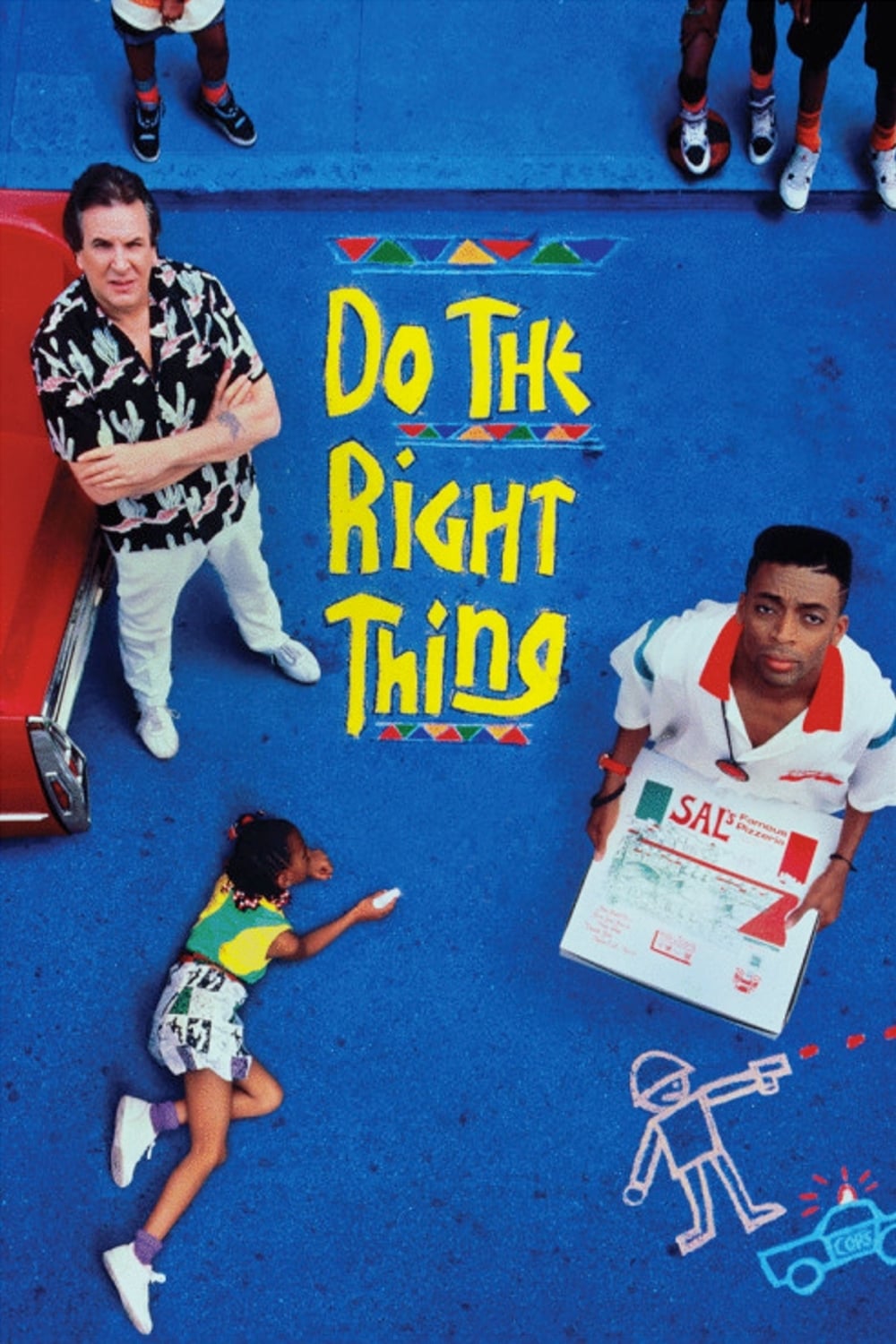
The Historical Era of the Film
Every time I revisit Do the Right Thing (1989), I can’t help but contextualize my reactions within the late 1980s—the turbulent backdrop in which the film emerged. This was a period when the United States was grappling with a dramatic set of shifts, both visible and subtle, in its political and economic spheres. Ronald Reagan had just left office, succeeded by George H. W. Bush, but the policies and attitudes of the Reagan era still loomed large. For me, this was a time defined by high-profile political debates over urban decay, the so-called “war on drugs,” and a growing anxiety about violence in American cities.
I remember reading about how the 1980s were shaped by the decline of manufacturing jobs—a change that hit urban centers especially hard. Brooklyn, where the film is set, was facing the aftershocks of industrial flight, redlining, and a dwindling tax base. The economic struggles of this era were not only about abstract statistics—they showed up in boarded-up storefronts, rising unemployment, and entire neighborhoods left with little investment or hope. The 1987 stock market crash (known as “Black Monday”) made the fragility of the economy all the more apparent.
On the political front, the crack epidemic dominated headlines, and it shaped the dominant narratives about Black and Latino communities. Federal policies focused on punitive measures, resulting in a skyrocketing prison population—predominantly young Black men—while community resources continued to evaporate. As I think back to that time, it’s clear that urban policy was heavily influenced by law-and-order rhetoric, often overshadowing efforts at social reform. The rising national conversation on race relations was emotionally charged and inseparable from the pulse of daily life in the city.
And yet, despite all the difficulties, I witnessed communities remaining resilient, constantly reinventing themselves amid adversity. The artistic, musical, and cultural innovation of the 1980s—especially hip hop, graffiti art, and a renewed focus on Black identity—demonstrated the spirit that persisted through tough times. When I consider Do the Right Thing’s historical era, these textures of crisis and resistance seem to frame every scene and decision. Spike Lee didn’t just reflect his time; he captured the precise sense of flux and uncertainty that made the late 1980s so distinctive.
Social and Cultural Climate
When I try to understand what Do the Right Thing was responding to, I come back again and again to the social and cultural climate that characterized that moment in New York City’s history. For me, the city in 1989 existed in a palpable state of tension—a powder keg of accumulated grievances, institutional neglect, and the endlessly creative ways people maintained their dignity and joy. It was an era defined by racial polarization, but also by tremendous cultural dynamism and the creation of new kinds of community identity.
The late 1980s saw several real-world flashpoints that shaped public consciousness around race and authority. I vividly recall following the stories of Michael Stewart’s death in 1983, Eleanor Bumpurs in 1984, and the Central Park Five case in 1989—all highly publicized incidents of police violence or miscarriage of justice involving Black or Latino New Yorkers. Each case seemed to escalate mistrust in policing and generate new calls for accountability. Across neighborhoods, residents often described a sense of being both over-policed and under-protected.
New York’s popular culture was struggling with, and reflecting, the contradictions of this era. The explosion of hip hop, the sharp political humor of late-night radio, and the assertion of Black and Puerto Rican pride challenged mainstream media narratives of disorder and decline. Spike Lee himself had already entered national conversation with his earlier films—such as She’s Gotta Have It—becoming a leading voice in what I saw as the new Black film renaissance. There was a surge of interest in recognizing how different groups experienced city life, and not just as passive subjects but as actors in their own right.
Dominant attitudes about race relations ranged from hopeful to deeply cynical: I often sensed a rift between those advocating for integration and dialogue and those entrenched in suspicion or outright animosity. This was a period when terms like “melting pot” were fiercely debated. The summer heatwaves that plagued New York in the late 1980s, with their associations with spikes in tension and violence, added another layer of metaphoric resonance to the city’s mood. I think of these sweltering days as both literal and symbolic expressions of the underlying frictions in Brooklyn and beyond.
A few key historical elements of the social climate in 1989 stand out to me:
- The aftermath of several high-profile cases of police brutality with unresolved justice
- Rising national visibility of hip hop and Afrocentric cultural expression
- Growing economic disparity between city neighborhoods and other regions
- A visible push for ethnic and racial solidarity in response to marginalization
The day-to-day realities of city life—shared apartments, gentrification, contest over public space—seemed to foster both conflict and unexpected alliances. When I watch Do the Right Thing, I see the film as a direct response to these unresolved tensions: the sense that the possibility of both eruption and renewal was always lurking just beneath the surface.
How the Era Influenced the Film
The more deeply I consider the relationship between Do the Right Thing and its production era, the more I appreciate the ways historical forces left their fingerprints on every artistic choice. It’s impossible for me to separate the film’s storytelling, characters, and even its look from the America of 1989. The environment of late-Reagan America—with its anxieties about urban disorder and shifting demographics—infiltrated the script, casting, set design, and musical choices. As someone invested in film history, I’m struck by how Spike Lee didn’t hedge or generalize; he made the setting his north star.
Visually, the film pulses with the heat and color of a Brooklyn block in midsummer. I interpret this as deliberate: the relentless sun, the sweat on characters’ faces, the vivid mural of Martin Luther King Jr. and Malcolm X, all situate the story within a neighborhood that has weathered generations of hope and heartbreak. Lee drew on real city signage, slang, and music, creating a sense of verisimilitude that is intimately connected to the 1980s’ emphasis on authenticity. The omnipresent soundtrack—led by Public Enemy’s “Fight the Power”—doubled as a rallying cry from the hip hop generation, which was itself a product of the very socioeconomic stressors affecting places like Bed-Stuy.
What stands out to me, too, is the way Lee populated his cast with an intergenerational range of characters—seniors who recall the “old neighborhood,” teens shaped by contemporary urban culture, business owners struggling with both history and present-day conflict. I see this as reflecting the multifaceted legacy of urban America, where long-standing traditions are constantly being rearticulated in the face of new economic and political realities. The character of Radio Raheem, for instance, resonates with me not merely as a dramatic figure, but as a living symbol of the era’s resistance and pride.
It’s hard to ignore, as well, how the script’s focus on escalating conflict mirrors what I remember as the frequent news coverage about “racial violence” and urban uprisings. The film’s production was contemporaneous with ongoing debates about gentrification, the fate of small businesses, and who has the “right” to occupy public space. I am often reminded that these debates persisted long after the film’s credits rolled, with the images and questions from Lee’s film serving as both a record of their era and a warning about cycles that seem to repeat every few decades.
I find it fascinating that the film’s ambition wasn’t just to represent a moment but to distill the pulse of a city in flux—the uncertainty, the warmth, the conflicts and convergences, all shaped by the specific social DNA of 1989.
Audience and Critical Response at the Time
When Do the Right Thing opened, my experience mirrored that of many critics and viewers: a visceral reaction, as though the heat, sound, and energy had left the theater and entered the world outside. I recall intense and sometimes uneasy debates in newspapers, classrooms, and among friends about what the film “meant” and whether it might provoke real-world unrest. The release came only two years after my city had witnessed protests over police violence, making the film feel less like entertainment and more like an urgent intervention into national conversation.
I remember how divided the responses were. Some appraised Lee as a fearless chronicler of contemporary urban life—someone willing to ask questions others avoided. Others accused the film of irresponsibility, or even inciting division. The conversation often centered on the climactic riot, with some critics and public figures (including then-President Bush) speculating about whether audiences would “do the right thing.” The controversy, I believe, was a measure of how raw and exposed the relevant social issues still felt. There was a fear, rarely articulated plainly, that the film was not just reflecting history, but actively shaping and challenging it.
Critical reviews at the time, as I recall, ranged from the admiring (Roger Ebert, for example, considered the film not only relevant but necessary) to the skeptical. The Academy Awards’ limited recognition—overlooking the film for Best Picture—felt to me like evidence of how deeply the dominant institutions were still wrestling with how to include work from directors like Lee. Black and Latino artists and scholars, though, often viewed Do the Right Thing as groundbreaking, declaring it a watershed moment for American cinema and discussions of race relations.
Among audiences, particularly those living in New York, the response seemed intensely personal. People brought their own histories, prejudices, and allegiances to the viewing, and the film prompted passionate conversations about responsibility, blame, and hope. In retrospect, I see Do the Right Thing as both a mirror held up to its original audience and a litmus test for how far the conversation about race and justice had come—or had yet to go.
Why Historical Context Matters Today
When I think about why understanding the historical context of Do the Right Thing is so crucial today, it’s not only as a film historian but as someone who has felt echoes of those late 1980s tensions reverberate across decades. For me, watching the film without a grasp of its origins means missing not just the story’s drama, but the lived reality to which it responds. The world of 1989 is far from dead; I see its legacy in today’s news, social movements, and community dialogues.
Knowing how the film grew out of real-world experiences of police brutality, economic marginalization, and urban neglect transforms its meaning for me. It’s not simply a work of fiction, but part of a broader tapestry of expression, protest, and survival. Recognizing the importance of integration and resistance in the late 1980s adds depth and urgency to every image and line of dialogue. When audiences engage with Do the Right Thing now, I believe they are participating in a cross-generational conversation about what it means to live together amid difference and inequality.
The questions the film raises—about power, voice, and belonging—are not relics of history, but living concerns. My own sense is that to appreciate the bravery, tension, and inventiveness of Lee’s work, viewers today must situate themselves within the world that produced it. That means grasping not just the personal but the political stakes at play in each confrontation and alliance. Historical context, for me, is not just background; it’s the very fabric that gives the film its resonance and urgency.
In returning to Do the Right Thing, I find myself compelled to see both its warnings and its affirmations as present, active realities. The film continues to shape and reflect debates on justice, community, and American identity. A fuller understanding of its historical context transforms it from a singular artistic achievement into a touchstone for dialogue—one that asks me, and all viewers, to remember where we’ve been and interrogate where we’re going.
After understanding the factual background, you may want to see how this story was received as a film.
🎬 Check out today's best-selling movies on Amazon!
View Deals on Amazon