
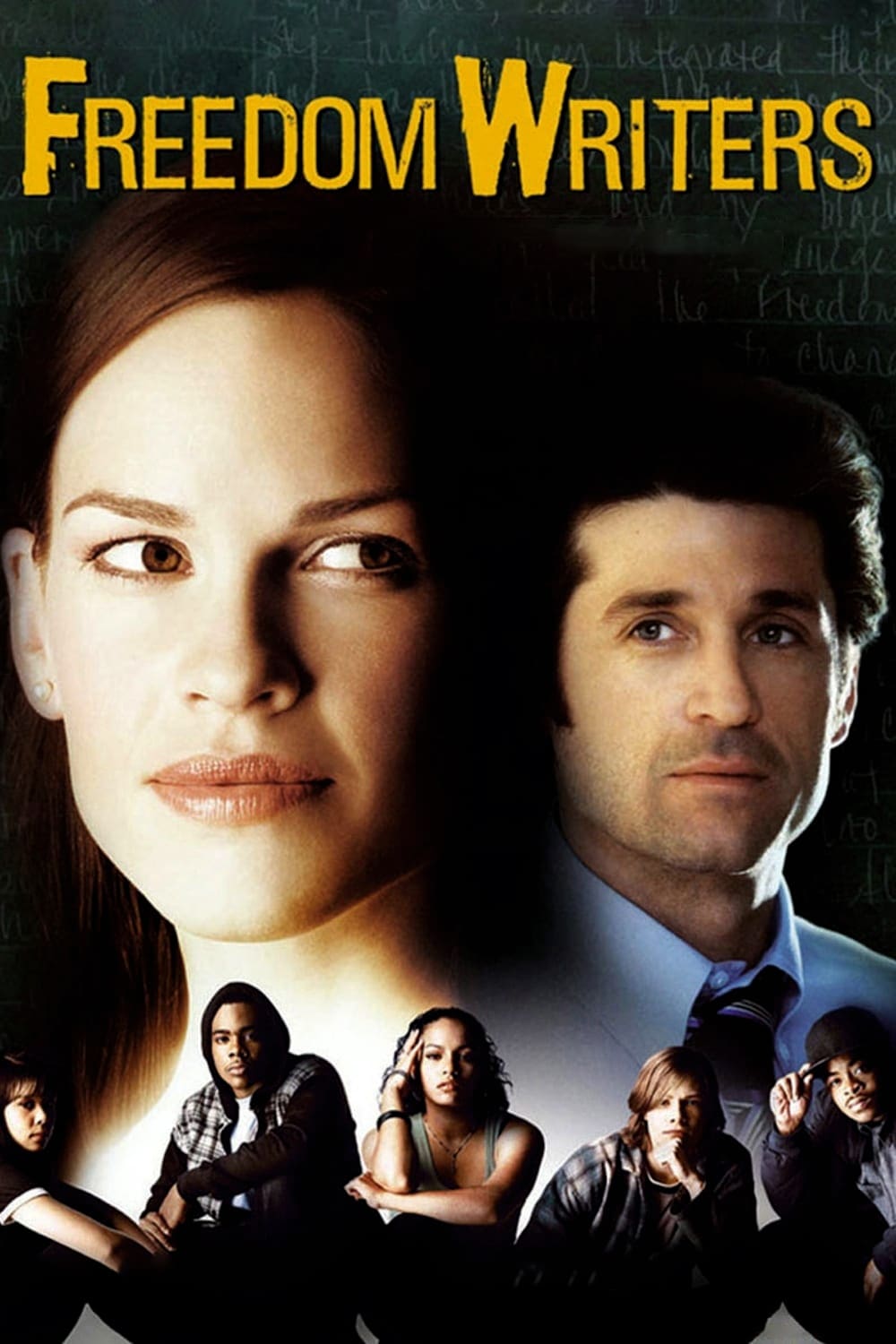
The Historical Era of the Film
Whenever I revisit Freedom Writers (2007), I feel an unmistakable pull to the specific political and social environment in which it emerged. This was not simply a high school drama; it was a product of early 2000s America, a moment saturated with post-Los Angeles Riot anxiety and simmering concerns about education reform. Looking at the country in the early years of the twenty-first century, I remember the unrest that still lingered from the 1992 Los Angeles Riots. The city’s wounds hadn’t healed—racial mistrust, poverty, and urban violence still shadowed many neighborhoods, especially those like Long Beach where the film’s story takes root.
It was a time when the so-called “achievement gap” in American public schools became one of the most widely debated topics in education. The No Child Left Behind Act, passed in 2002, was in full swing, and education policy found itself at the heart of national discourse. I clearly recall the way the act pressured schools to close the gap in test scores between minority and white students, which only gnawed at existing anxieties about fairness and equal opportunity.
The broader political atmosphere was still bruised from the trauma of September 11, 2001. During those years, I sensed a fortress mentality—security concerns dominated headlines, racial profiling spiked, and American identity itself became a contested idea. Meanwhile, the economy of the early 2000s was turbulent. Though the country rebounded from the brief dot-com recession, many working-class families, particularly those from immigrant or minority backgrounds, watched economic opportunities remain frustratingly limited in rapidly gentrifying cities like Los Angeles.
When Freedom Writers arrived in theaters, these undercurrents were palpable for me: urban education in crisis, race relations still volatile, and a growing divide over what constituted real reform. The film’s release in 2007 sat at the crossroads of a deeply divided America—one where public education, race, and youth violence collided almost daily in the national consciousness.
Social and Cultural Climate
The cultural temperature during the early 2000s, as I remember it, was shaped by sharp debates over representation, inclusion, and what counted as “real” American culture. School shootings, media portrayals of violence, and fierce arguments over multiculturalism dominated the headlines. I think back to the way mainstream entertainment—whether television, music, or film—began grappling more directly with questions of diversity. “Inner-city” stories gained traction, but there was still controversy about whether Hollywood’s representations did justice to those they depicted.
Gang culture, though not new, was still being sensationalized in mainstream media, and I can’t forget how this lens painted so many young people of color as inherently “troubled” or “dangerous.” The backdrop of the Rodney King video and subsequent riot in 1992 lingered in the public imagination; now, more than a decade later, I noticed racial profiling hotly contested but stubbornly persistent among police and educators alike.
Hip hop and urban fashion moved from countercultures to mainstream phenomena, but they also drew criticism from those who saw them as glamorizing “the wrong values.” As a historian, I reflect on just how hard it was for students living in marginalized urban communities to assert a narrative different from what was fed to the American public. The early 2000s’ push for “colorblindness”—driven by political leaders who suggested society should look past differences—in reality, collided awkwardly with the lived experience of most minority youth, who saw those differences exploited or ignored.
I observed the rise of youth activism during this era, especially after the turn of the millennium. Conversations around intersectionality, immigrant rights, and educational justice, while not yet part of everyday vocabulary, began to gain traction. Freedom Writers embodied these messy, contradictory energies: a yearning for real understanding, a critique of the status quo, and a tentative hope for grassroots change, even against a backdrop of systemic inequality.
- Lingering effects of the 1992 Los Angeles riots and urban unrest
- National focus on education reform with the No Child Left Behind Act
- Heightened debates about race, multiculturalism, and representation in media
How the Era Influenced the Film
To me, what’s most compelling about Freedom Writers is how inseparable it feels from the anxieties and hopes of its era. It’s easy for me to see how the filmmakers drew inspiration from actual social issues gripping early 2000s Los Angeles: overcrowded classrooms, segregated school districts, youth violence, and the day-to-day grind of immigrant life. The setting in Long Beach, an area I know was struggling with school integration and post-riot tension, felt less like a backdrop and more like a character in itself.
When I study the film’s characterizations and dialogue, I see the echoes of real-life teachers squeezed by administrative policies demanding higher test scores but giving little guidance for reaching students traumatized by violence, displacement, and poverty. The film’s protagonists—both teachers and students—carry the emotional residue of their time. I notice, for example, the presence of students from various racial backgrounds (African American, Latino, Asian, and White), mirroring the demographic complexity of urban Los Angeles in the early 2000s. These characters weren’t only figures from a textbook; they represented the generation whose education was being shaped, and sometimes stifled, by top-down reform efforts.
The tension between hope and disillusionment is what defines my reading of the film. The production era’s debates about charter schools, standardized testing, and public investment in education are never far from the surface. I sense the filmmakers grappling with whether an individual teacher’s compassion could actually counterbalance systemic neglect. Hollywood’s interest in “true story” dramas about educators reflected the hunger for narratives in which personal dedication made a tangible difference, regardless of overwhelming odds.
For me, the production’s conscious choice to frame the classroom as a battleground doesn’t feel accidental. The social climate demanded a story about survival—both academic and literal—in a world that often dismissed these students as “lost causes.” The film’s docudrama approach, echoing trends from recent Oscar winners and acclaimed social-issue films, spoke to an audience wrestling with the realization that these stories weren’t just cinematic make-believe—they were playing out daily in America’s own backyard.
Audience and Critical Response at the Time
As I remember it, the release of Freedom Writers triggered a spectrum of reactions that mirrored the issues at its core. I’d hear educators rave about its inspirational message—particularly those teaching in underfunded or majority-minority schools, who saw in it a validation of their everyday struggles. It’s vivid in my memory how some teachers and students even started student “Freedom Writer” journals as classroom projects, inspired by the film’s example. Parents who feared for their children’s safety in urban schools sometimes found comfort or catharsis in seeing these stories gain a national platform.
Critics, especially those in mainstream outlets, wrestled with the film’s balance of earnestness and storytelling. Reviewers often praised Hilary Swank’s portrayal of Erin Gruwell but debated whether the film strayed into sentimentality—a criticism I find almost inevitable for “teacher hero” narratives after critical successes like Dangerous Minds in the 1990s. Still, what grabbed me at the time was how the film sparked new discussions in talk radio, school meetings, and even city councils about what it really took to transform a failing classroom, and whether a single teacher could overcome entrenched, systemic problems.
The social media landscape in 2007 was less developed than it is now, so much of the audience reaction happened offline or in early blog commentary. Diverse communities offered different readings: immigrant families, in particular, latched onto depictions of language barriers, intergenerational tensions, and the difficulties of assimilation.
Yet not everyone was satisfied. Some advocacy groups found the focus on a “white savior” problematic, drawing attention away from the students’ agency and the wider failures of the educational system. These criticisms, to me, underscored just how sensitive the topics of race and education remained—and how vital it was to keep these conversations alive.
Why Historical Context Matters Today
When I reflect on the importance of this historical context now, what stands out is how much richer my appreciation for Freedom Writers (2007) becomes when I see it as a by-product of its time. So many of the themes—racial divides, the struggle for underprivileged youth to have their voices heard, faith in the power of education—feel as urgent now as they did then. Without the backdrop of early 2000s Los Angeles, with all its anxieties and opportunities, the narrative loses not only its authenticity but also its bite. Every scene in the film, from the smallest classroom exchange to the moments of confrontation outside school walls, echoes the social realities I remember so well from that period.
For me, understanding that this film was born in the era of post-riot Los Angeles and national educational overhaul completely changes the viewing experience. It is not merely a tale about troubled youth and a dedicated teacher—it’s a historical document, capturing on screen the challenges, dreams, and heartbreak of a generation caught in the crosshairs of policy and circumstance. Even now, the unresolved debates about testing, funding, and the emotional safety of minority students are not relics of the past but ongoing struggles. The historical context sharpens each scene, allowing me—and, I believe, anyone watching with awareness—to engage more deeply with the story’s stakes and its relevance to today’s debates.
After understanding the factual background, you may want to see how this story was received as a film.
🎬 Check out today's best-selling movies on Amazon!
View Deals on Amazon