
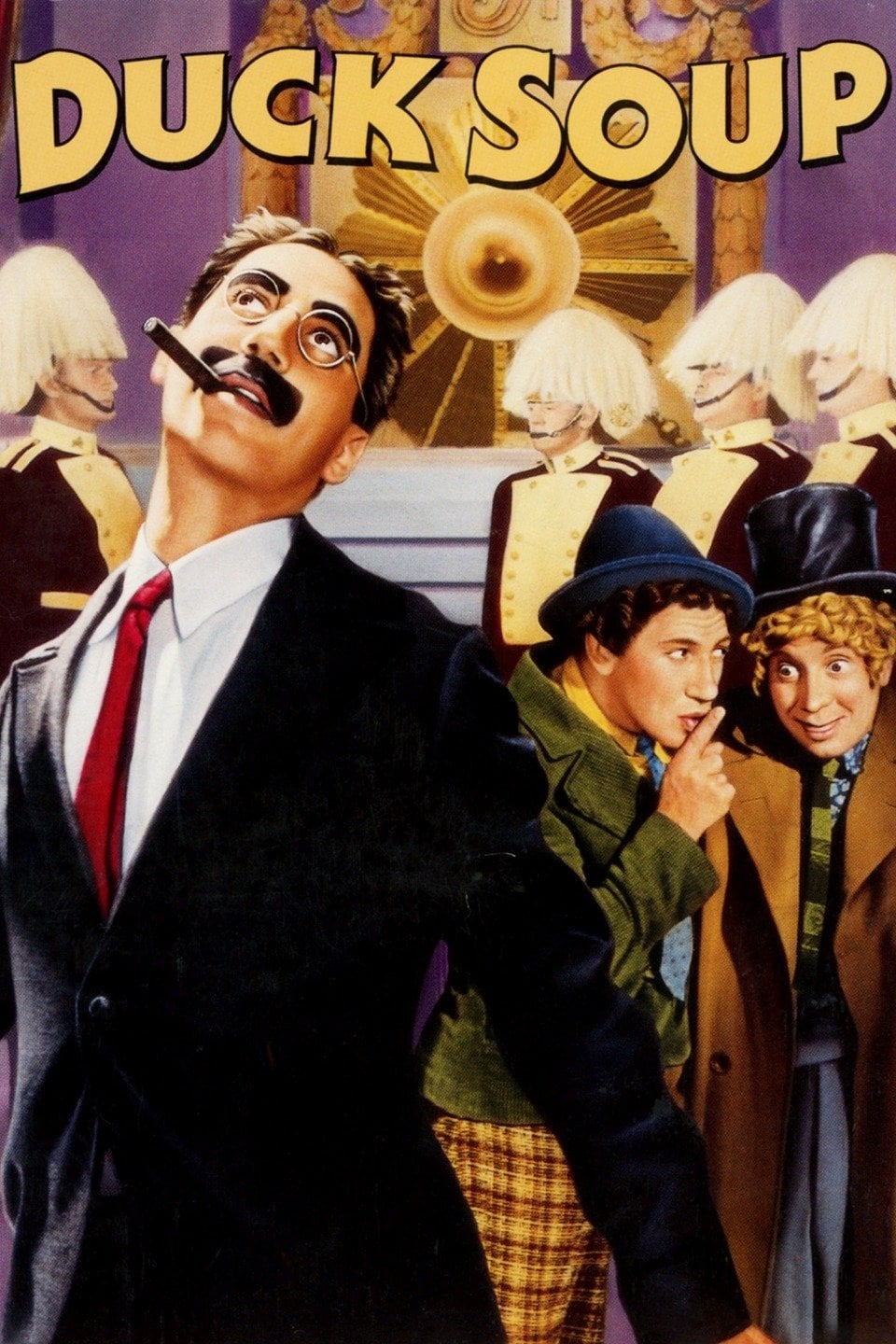
The Historical Era of the Film
Whenever I watch Duck Soup (1933), I can’t help but imagine the kind of world my grandparents might have inhabited when this anarchic comedy first appeared on the screen. The historical context surrounding its release is nothing short of extraordinary, shaped most dramatically by America’s deep struggles during the Great Depression. I always picture towns burdened by economic collapse – unemployment was rampant, banks had failed, and even in Hollywood, anxiety was thick in the air. Politically, this was a season of radical uncertainty. Franklin D. Roosevelt, newly inaugurated, was launching the earliest components of the New Deal in an effort to revive the nation’s shattered confidence and battered markets. The country’s optimism was being sorely tested. For me, imagining average Americans lining up outside theaters in worn shoes, holding onto their last coins for a moment’s escape, puts the importance of films from this production era into sharp relief.
Internationally, the early 1930s cast a long shadow. Europe was just as uneasy – the Weimar Republic was collapsing, fascism was on the rise, and Japan’s imperial ambitions were spilling into Manchuria. Many Americans, though, remained deeply isolationist, wary of foreign entanglements after the trauma of World War I. Still, a growing sense that the world order itself was shifting cannot be overstated. The sound film was relatively new, barely five years old, yet Hollywood’s influence was already global. Against this complex political and economic backdrop, Duck Soup emerges for me as a film both shaped by, and fiercely reacting to, the times in which it was made.
- The Great Depression shaped nearly every facet of American life
- Political unrest fostered a climate of anxiety and distrust
- Isolationist attitudes defined much of the national mood
- The global rise of fascism threatened traditional democracies
When I immerse myself in the period’s history, I’m struck by how quickly social morale could shift from hope to cynicism. There was real desperation for relief – not just materially, but emotionally and psychologically. The movies that endured from this period, Duck Soup included, often provided sanctuary from these daily pressures, and yet, they couldn’t help but reflect the clouds gathering at every horizon.
Social and Cultural Climate
The dominant social attitudes and cultural frictions of the early 1930s are never far from my mind when I study this film. Americans at this time were struggling to come to terms with the sudden collapse of beliefs they’d long cherished. Faith in government, business, and old social hierarchies was profoundly shaken. An air of irreverence had started to seep into popular culture, visible not only in film, but in vaudeville, radio, and print satire. I sense that people were looking, almost with desperation, for a way to poke fun at – or outright mock – the political and institutional failures they witnessed all around them.
In this respect, the comedy of the Marx Brothers feels tailor-made for the decade’s pervasive disillusionment. Their unique energy – chaotic, clever, subversive – directly challenged both authority and decorum. I see echoes of widespread skepticism toward leadership, as many citizens watched corrupt politicians and business tycoons evade accountability while the average person struggled to survive. For some, this was an era of profound hope in public works and social solidarity. For others, simmering resentment boiled over into strikes, protests, and even violence.
At the same time, cultural trends such as prohibition’s recent repeal and the rise of mass culture significantly shaped the social climate. The film industry itself existed in a curious intersection between daring creativity and strict self-censorship, with the Pre-Code Hollywood years allowing a brief window of permissive, edgy humor and topical satire. Although the Production Code was in the process of tightening its grip, films like Duck Soup could still push against moral boundaries and skewer sacred cows in a manner that would soon become difficult.
I interpret all of this as reflective of a kind of manic rebellion—an eagerness to laugh at the absurdity underpinning not just government, but traditional institutions as a whole. I believe that audiences didn’t just watch these films for escape; they also sought them out for their cathartic ability to voice, however humorously, their growing sense of alienation from the official channels of power and “proper” conduct. The film’s wild, almost apocalyptic style of comedy perfectly mirrors the cultural turbulence of its time.
How the Era Influenced the Film
The more I revisit Duck Soup, the more convinced I become that its very narrative skeleton couldn’t exist apart from its production era. The story lampoons inept dictators and government bluster, which to me reads as a biting caricature of the political climate in America and abroad. My mind constantly returns to the deeply unsettled world order of the early 1930s—the rise of Mussolini, Hitler, and a swirl of authoritarian figures. It’s no accident, from my perspective, that Groucho Marx’s “Rufus T. Firefly” is a self-important, clueless ruler of the fictional Freedonia: an emblem of both the laughable and lethal potential in unchecked leadership.
The visual style and pace of the film, too, have always struck me as emblematic of the era’s artistic daring. The rapid-fire gags, unpredictable narrative, and surreal set pieces show off a freedom that came in part from Hollywood’s then-loose censorship. I believe the tonal chaos and anarchy weren’t just artistic decisions; they reflected a deeper societal turbulence, an impatience with conventional order that, for me, mirrored the chaos of the real world outside the theater doors.
In the details of its satire, I see a kind of coded bitterness born of the Depression’s hardships and the failures of political institutions—a sobering, if comical, expression of Americans’ growing sense of futility with established authority. From my vantage point, the Marx Brothers’ irreverence often feels like a direct answer to the cynical questions so many Americans were afraid to ask openly. Would government ever truly serve the people? Did the old rites and ceremonies actually matter when breadlines stretched for blocks?
Even the production choices—its extravagant musical numbers, relentless pace, and gleeful disregard for plot coherence—strike me as products of their time. Studios, anxious for box office returns and public favor, took big risks on recognizable vaudeville acts and unconventional humor, hoping that sheer energy and outrageousness might distract from broader economic and existential anxieties. I read these decisions as both pragmatic and revolutionary, as if the filmmakers knew there was no going back to the old forms after so much domestic and international upheaval.
Audience and Critical Response at the Time
Reflecting on how contemporary audiences and critics engaged with Duck Soup reveals a fascinating split between expectation and reaction. I’ve always been fascinated by the fact that, on release, Duck Soup landed with a much more muted thud than its later cult status might suggest. Many viewers, weary after years of economic devastation, weren’t always ready for the relentless chaos and subversive tone. Some were confused by the film’s lack of sentimental grounding or traditional narrative safety nets. Many expected light, harmless escape; what they found was a bold, sometimes abrasive, satire of authority.
For me, reading contemporary reviews is a journey through ambivalence and occasional dismay. Prominent critics in 1933 often expressed unease with the film’s open mockery of sacred institutions, particularly at a moment when national unity and faith in government were at a nadir. It’s clear to me that while the Marx Brothers had their passionate followers, mainstream taste was still adjusting to such raw, anarchic comedy. I imagine audiences divided: some roaring in the aisles, others shaking their heads in bewilderment, unsure if this style of comedy was what the moment demanded.
Commercial reception was similarly complicated. Although the film is now regarded as a classic, box office numbers at the time fell short of studio hopes. I suspect this came from Duck Soup’s refusal to offer easy comfort or easily digestible morality. Instead, the film asked viewers to join in an extravagant farce that directly poked at the follies and failures of everyday life. In retrospect, I see this as a remarkable act of artistic courage, even if it cost the filmmakers immediate acclaim.
Over the years, though, I’ve watched Duck Soup’s reputation transform. As new generations brought fresh perspectives, what once confounded some viewers began to seem visionary. To this day, tracing the arc of its reception helps me see not just what audiences wanted, but what they needed – and how time can radically shift the meaning of art depending on when, and how, it’s viewed.
Why Historical Context Matters Today
When I revisit Duck Soup now, I find that grasping its historical context radically deepens my appreciation for what the film dared to attempt. Understanding the social climate – the despair, the skepticism, the need for both rebellion and relief – brings layers to the jokes and to the chaos that might otherwise seem random. It’s impossible for me to watch Groucho Marx’s merciless lampoon of statecraft without thinking of the headlines my ancestors would have read that very week: bread riots, political scandals, the rise of strongmen abroad. I feel that the laughter, both in the theater and on the screen, was fighting something much larger than itself.
For me, the film embodies a historical defiance, a willingness to not only question authority but to tear it down laugh by laugh, line by line. I realize that in times of hardship, humor can become both a balm and a weapon. Today’s audiences encounter Duck Soup as a piece of vintage entertainment, but understanding the anxieties and aspirations that animated its creation brings the work to life in a new way. I’m constantly reminded how art and history are symbiotic: art shapes our understanding of a moment, even as that moment forever marks the art itself.
The importance of this context becomes especially clear when debates about government, freedom, and power once again take center stage in society. Duck Soup returns, again and again, not just as a funny movie, but as a historical voice – irreverent, fearless, and unbowed by circumstance. I don’t just enjoy the slapstick; I admire the audacity that could only be born from such pressures. Without its time and place, Duck Soup would be a vastly different film – or perhaps not exist at all.
By reflecting on its roots, I see how the film manages to function as both a time capsule and a cautionary tale. Whenever I recommend it to friends or students, I always suggest they first spend a moment with the story’s real-world backdrop. Only then, I think, can we truly savor, and be shaken by, the full power of its historic laughter.
After understanding the factual background, you may want to see how this story was received as a film.
🎬 Check out today's best-selling movies on Amazon!
View Deals on Amazon