
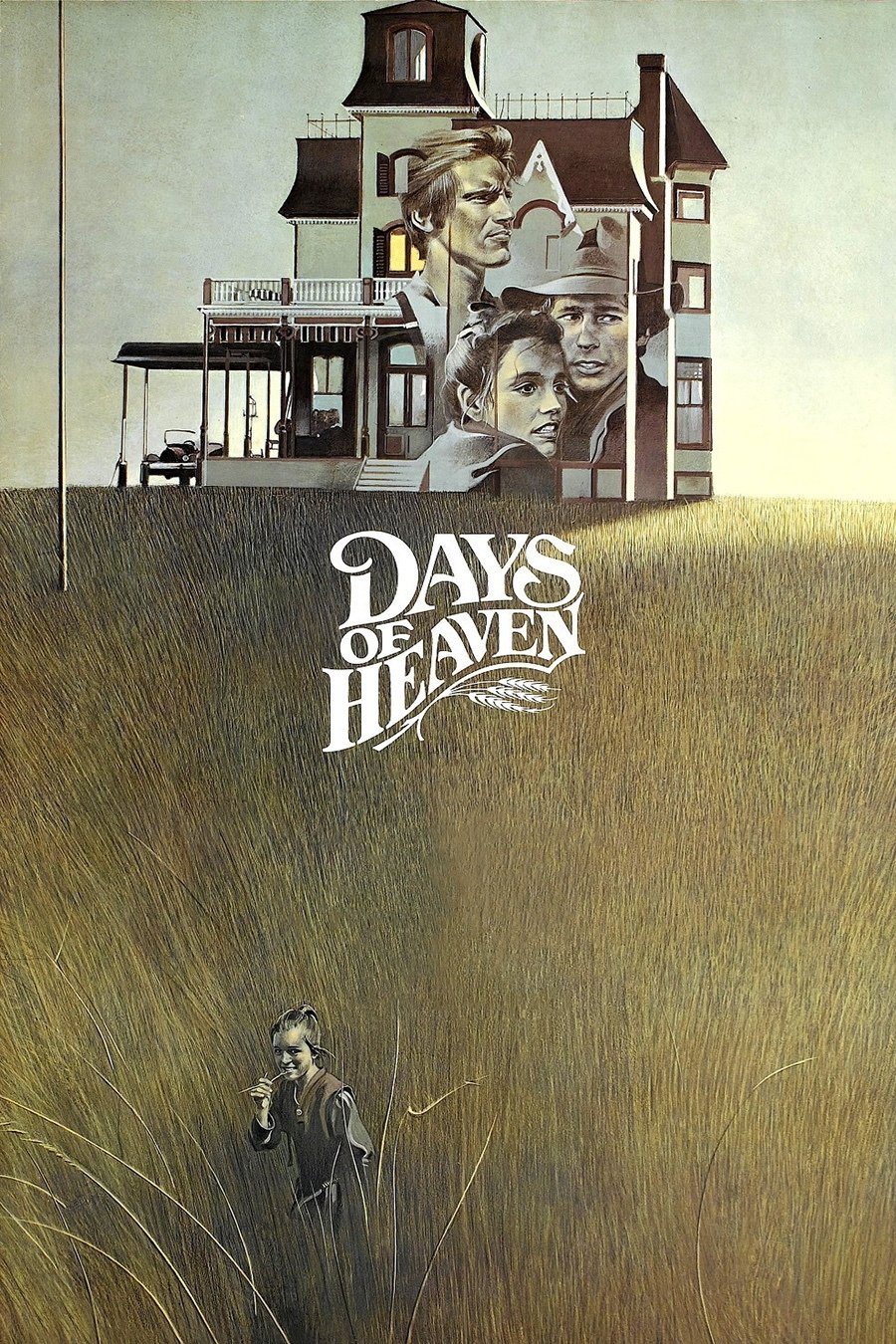
The Historical Era of the Film
Whenever I reflect on Days of Heaven (1978), the landscape that first comes to mind is not merely the wheat fields from its cinematography, but the America from which the film’s spirit was born and the late 1970s context in which it was made. As a film historian, my fascination always circles back to the late 1970s—an era wracked with economic challenges, political disillusionment, and emerging currents of social change. Post-Vietnam America was still healing from both visible and invisible wounds. I always sense how the Watergate scandal and President Nixon’s resignation had left society with a pervasive skepticism toward authority and official narratives. This was not just a moment of political scandal, but a crisis of trust.
Economically, stagflation defined the latter half of the decade: inflation ran high even as unemployment lingered, putting pressure on families from every background. Although the rural period depicted in Days of Heaven draws us back to the 1910s, I can’t help but see the traces of 1970s anxieties embedded in the production, especially that sense of transition and instability. Wages stagnated for working-class Americans, and the dream of unfettered advancement felt more hollow with each passing year. To me, this resonates with the film’s portrayal of drifters seeking fortune on the open plains.
Socially, the mid-to-late 1970s witnessed what I would describe as a national sense of searching—not simply for economic recovery or political honesty, but for some essence of American identity itself. I always view the slow retreat from utopian optimism, a retreat made tangible in the way cinema of the era looked backward to capture earlier periods. Whether through nostalgia or critique, films from the 1970s often critiqued the present by immersing themselves in the past. There’s so much richness in how these currents ripple beneath the surface of Days of Heaven’s period setting.
In practical terms, the production era shaped the entire film industry, too. The so-called “New Hollywood” movement was still strongly at work—directors like Terrence Malick, who made this film, were favored with a rare degree of creative autonomy. Studios, desperate for critical success after the collapse of the big studio system, were remarkably willing to take risks on ambitious, even idiosyncratic projects. That freedom is something I feel in every slow tracking shot and every whispered line of narration in Days of Heaven—a film that could only have emerged in an era where personal vision was momentarily allowed to flourish.
- The aftermath of the Vietnam War
- Economic instability and stagflation
- Growth of director-driven “New Hollywood” films
- Public skepticism towards politics and authority
Social and Cultural Climate
Diving deeper into the late 1970s, I find the social climate in America particularly relevant to the textures of the film. When Days of Heaven was production, the nation was navigating a complicated web of cultural shifts. There was no single, dominant attitude, but rather a cacophony of voices—each vying to make sense of change. The movements of the previous decade, especially the Civil Rights Movement and the counterculture revolution, had left their mark on every social institution. People my age at the time vividly recall how disillusionment blended with yearning. I sense a distinct anxiety about the American dream; people weren’t quite ready to let it go, nor convinced it ever truly belonged to them.
Films from this period often embody a melancholic nostalgia, an urge to reconstruct or deconstruct the past. I see this trend reflected clearly in Days of Heaven, which chooses to frame its tale within the vistas of rural Texas during the 1910s—a period mythologized in American consciousness. It’s clear that the film’s look backward is not simply about setting, but about grappling with the authenticity and failures of the nation’s founding myths. The film’s central characters, who move through space as laborers and outsiders, echo the feelings of alienation that so many Americans felt during the 1970s. Unions, workers’ rights, and broad economic justice were topics of heated discussion, and these issues shaped the cultural imagination.
At the same time, the decade was marked by a notable questioning of traditional gender roles and a growing celebration of diversity, even if authentic diversity was rarely represented onscreen. The strength and ambiguity of female narrators in films from this era—like the young girl’s perspective in Days of Heaven—strike me as products of a time when people questioned both who gets to tell America’s stories and who is worthy of empathy. I believe the rise of environmental consciousness also seeps into the film’s imagery; after the first Earth Day in 1970, concern for the land itself became central to the national conversation. While not an overt activist film, the reverent way the camera traces the prairie grasses, or lingers on changes in the sky, feels to me like an homage to the newly awakened values of environmentalism.
How the Era Influenced the Film
For me, the imprint of the era is unmistakable in the very marrow of Days of Heaven. Terrence Malick’s approach to storytelling, with its patient pacing and elliptical structure, feels like an answer to the fast-changing ’70s—an era that often left people feeling unmoored and restless. I see his decision to center the film on transient workers, always moving, never secure, as a direct reflection of the instability facing countless Americans during the film’s release. The longing for rootedness, yet the fear of commitments tied to failing systems, shadows every character. I often dwell on the idea that the film’s rural nostalgia is less about the past itself, and more a way for its contemporary audience to process the uncertainties of their own time.
Notably, the labor conditions presented in the film—the seasonal farm work, the harshness of labor disputes, and the distant, almost mythic quality of the landowner—resonate with the resurgence of conversations around class and justice during the 1970s. To my mind, the immigrant experience depicted in the film recalls the broader debates of the period over national identity and what it means to belong. Immigration, assimilation, and the struggle for stability were ongoing realities for many families as the United States witnessed waves of newcomers from Asia, Latin America, and elsewhere. The characters’ rootlessness in Days of Heaven reads to me as almost an allegory for the search for belonging found everywhere in the late ’70s cultural psyche.
From a production perspective, I am drawn to how New Hollywood directors prioritized authenticity and realism. Filming mainly at “magic hour,” Malick’s team chased the golden light to evoke both beauty and impermanence—qualities that poetically underscored the transitory spirit of the age. The languid, observational pace, too, was a luxury granted seldom before or since to big-budget American films. The tension within the film—the struggle between pastoral idyll and looming disaster—mirrors what I interpret as the national mood: an attraction to innocence and beauty on the precipice of decline. In this way, the historical moment is woven intrinsically into the storytelling style itself, giving the film a contemplative emotional resonance that I believe only makes sense when understood through the lens of its own time.
Audience and Critical Response at the Time
When Days of Heaven reached audiences and critics in 1978, I sense that its reception was colored as much by prevailing tastes and expectations as by its undeniable craft. At the time, people were growing accustomed to more introspective, auteur-driven works, but Malick’s film pushed even these boundaries with its heavy use of visual storytelling and sparse dialogue. I remember the divided critical response: film critics showered the movie with acclaim for its photography—Néstor Almendros’s cinematography was instantly heralded as groundbreaking—but others found the story veiled, its characters opaque. To my eye, this tension mirrored the broader shifts within American cinema, where audiences and critics alike still wrestled with the transition from old conventions to a cinema obsessed with mood, tone, and the ineffable.
Many viewers in 1978, I find, were yearning for clarity and emotional immediacy after a decade of turbulence. The film’s quiet, elliptical nature challenged those expectations, leading some to feel distanced from the material while others praised its ambition. I spoke with older colleagues who attended early screenings and describe the film as “mesmerizing” but “difficult”—not simply to watch, but to process. Yet, I notice that art-house audiences were especially receptive, championing the film as a masterpiece and elevating it quickly within cinephile circles. The Academy Awards honored its cinematography, but many of its other merits, such as its singular narrative structure and evocative audio-visual style, were more slowly recognized.
This period also marked an interesting convergence between audience and critic: both groups were hungry for meaning, but often came away from Malick’s vision with more questions than answers. I would argue this is a signature product of its historical moment. The appetite for films that explored ambiguity and the margins of American mythos was growing, and Days of Heaven anticipated the deeper cultural reckonings still to come in the 1980s.
Why Historical Context Matters Today
Whenever I teach or write about Days of Heaven, I am repeatedly struck by just how much my appreciation is deepened through an understanding of its historical context. Without recognizing the late 1970s backdrop—its political uncertainties, its cultural reevaluations, its anxieties about work and identity—I would miss so many of the film’s textures and shadows. Today’s viewers, myself included, return to the film with different eyes, perhaps expecting the universal or the ahistorical. But it’s the film’s rootedness in its own production era that, I believe, makes it so haunting and enduring.
Knowing the social and economic climate—the labor unrest, the lost optimism, the debates over whose story is worth telling—transforms seemingly simple scenes into layered reflections on the American project itself. I see the laborers in the golden hour as stand-ins for all those struggling with uncertainty and transition, whether in 1916 or 1978 or now. The film’s meditative style, radical for its time, becomes a statement all its own about the right to pause and reflect amid chaos. When I understand how audiences of the late 1970s engaged with the film, I’m reminded how art does not exist in a vacuum, but always in dialogue with its moment.
Today, as economic and social anxieties return to the national conversation, I find the historical context of Days of Heaven instructive—reminding me that films often bear hidden records of their times. By attuning myself to the invisible threads between past and present, my engagement with the film becomes not just passive enjoyment, but a richer, more active form of viewing. It’s this bridge between eras—the late 1970s and our own—that I find most powerful and enduring in Malick’s quietly radical masterpiece.
After understanding the factual background, you may want to see how this story was received as a film.
🎬 Check out today's best-selling movies on Amazon!
View Deals on Amazon