
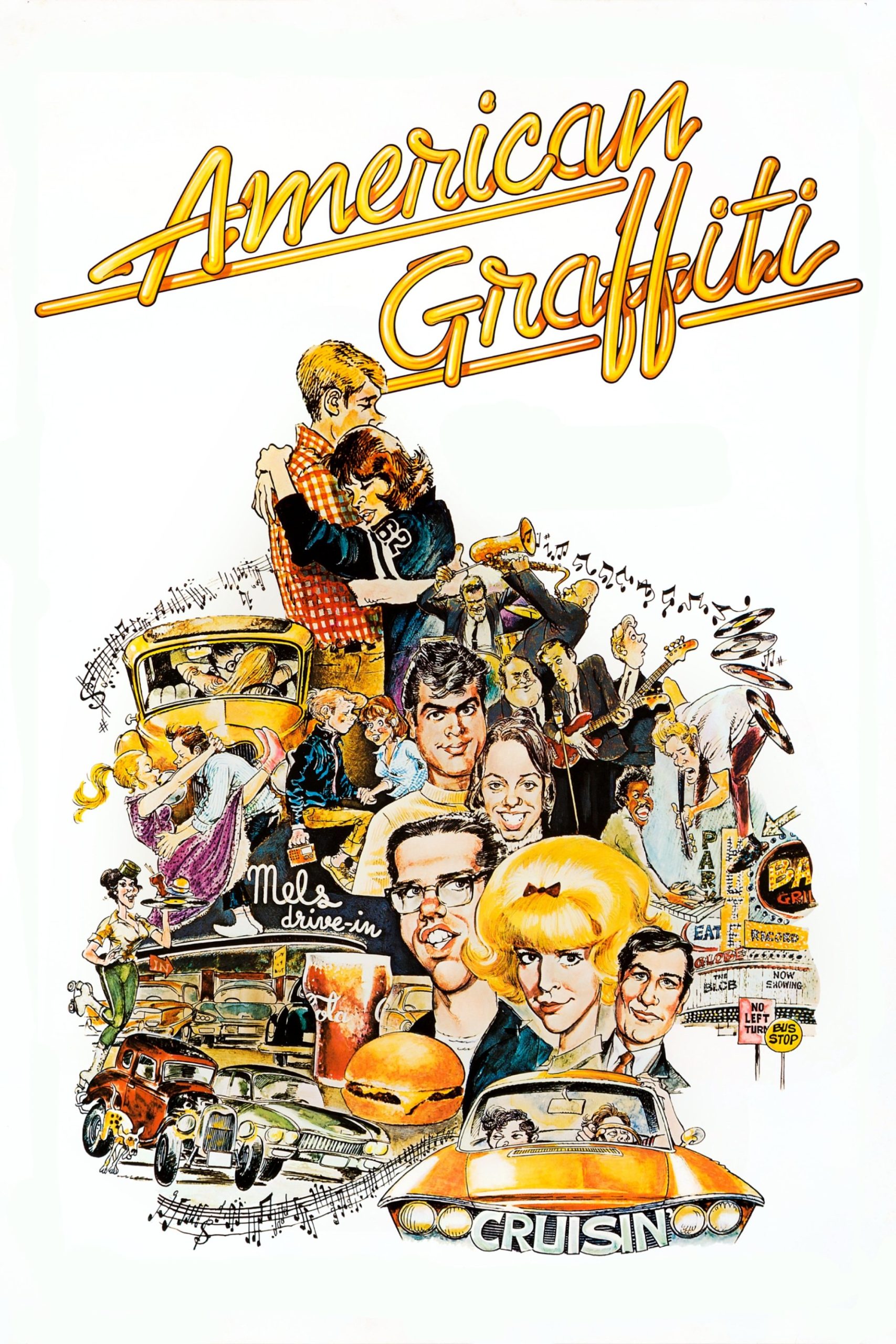
The Historical Era of the Film
Whenever I rewatch American Graffiti (1973), I’m acutely aware that its world wasn’t just conjured up in a vacuum—it’s deeply tethered to history. The American early 1970s were anything but calm. As I think about the political landscape, I recall the Vietnam War still raging on, with American society increasingly fragmented by protests, staggering losses, and government distrust. The Watergate scandal would soon burst onto the scene, but even before its full eruption, suspicion and weariness colored public opinion. Economic uncertainty began to shadow daily life; inflation rates climbed, the oil crisis loomed, and the optimism of the postwar boom was rapidly receding.
On a social level, I often picture a country mid-soul-search, a nation whose youth had clashed with traditional values throughout the 1960s, giving way to the counterculture movement. In towns across the U.S., especially in California where the film is set, I sense the echoes of race riots, civil rights struggles, and generational divides. The prevailing sense is one of transition and a longing—for some, a pull toward stability, for others, an urge for liberation and self-expression.
American Graffiti, produced in this volatile context, looks back deliberately at the recent past—specifically 1962—but it can’t escape the truth of its own era’s anxieties. I see a profound nostalgia for the cusp of the Kennedy years, just before the turbulence of assassinations, escalation in Vietnam, and more radical counterculture shifts. In some ways, the push and pull between the ghosts of the 1950s and the modernity dawning in the 1970s are everywhere in the film’s DNA.
Social and Cultural Climate
As I immerse myself in the film, I often notice how the social and cultural climate of the early 1970s heavily shades its tone and politics. The United States had watched traditional social structures erode over the previous decade; I’m reminded that young people were abandoning mainstream institutions like never before. The rise of the civil rights movement, second-wave feminism, and anti-establishment sentiments disrupted old patterns of race, gender, and class. The period was marked by apprehension, but also by an undeniable energy—a sense that barriers could fall and the future could be rewritten, sometimes chaotically, sometimes joyously.
The soundtrack of American Graffiti throbs with the heartbeats of 1950s rock and roll, taking me straight back to the era when teenagers built identities around cars, music, and late-night cruising. Yet, when I reflect on the film’s retro aesthetic, I see more than youthful innocence; I find the yearning of the 1970s generation for a time that seemed simpler, less fraught, and more hopeful. By 1973, the “American Dream” was under scrutiny and even siege, plagued by questions of war, scandal, and inequality. I can’t help but suspect that American Graffiti’s rose-tinted look at 1962 was as much about escaping the relentless change of the present as it was about celebrating the past.
For me, the tensions between conformity and rebellion. linger in every frame. Gender roles were being redefined at this time—outside the film’s world, women were demanding more agency, sexual freedom was contentious, and youth resistance had transformed cultural norms. Segregation had become legally outlawed, but real social equality still lagged, an issue reflected in the almost exclusively white social world of the characters. Modern viewers, myself included, now see this homogeneity as a document of what was then generally accepted, but also what was beginning to break apart. The film’s universe is specific—cruising through small-town California, the kids speak their dreams aloud in a language the counterculture had only begun to publicize.
How the Era Influenced the Film
I always see American Graffiti as a cinematic time capsule—a film that, while set in 1962, speaks volumes about the 1970s moment that created it. Director George Lucas, himself a product of the era’s shifting culture, made a conscious choice to revisit the world of his youth just as his country was unsure where it was headed. From my perspective, the selection of 1962 as the film’s setting was deliberate: it situates the story at the dawn of the transformative 1960s, an era that (in hindsight) marked the end of one cultural epoch and the beginning of another.
The production era’s restlessness infuses the movie’s narrative structure—a collection of restless young people on the brink of adulthood, hovering between childhood routines and the unknowns of maturity. I frequently detect echoes of the early 1970s in these restless, uncertain characters. The film’s fixation on cruising, radio DJs, and youth rituals isn’t just a memory; it reads, to me, as a meditation on innocence lost, about the fracture lines that would soon cut through American society. The threat of the draft, the seduction of big-city ambitions, the pressure to leave home—these were all issues contemporary youths were wrestling with as well.
The technological aspects of the film, such as the use of diegetic sound—radio tracks woven into the characters’ lives—reflect the era’s new wave in cinematic technique. There’s an energy here reminiscent of New Hollywood, a movement that encouraged filmmakers like Lucas to experiment with narrative form, realism, and character-driven storytelling, in sharp contrast to the studio productions of decades prior.
- The legacy of postwar prosperity was eroding by the early 1970s.
- The ongoing Vietnam War fostered social and political cynicism.
- The counterculture and civil rights movements redefined national identity.
- Rapid shifts in cinematic style reflected a broader desire for authenticity.
Being aware of these undercurrents helps me appreciate why Lucas and his collaborators looked back to their coming-of-age milieu. They were capturing more than just cars and jukeboxes—they were also capturing the collective hope and anxiety of living at the edge of change, an atmosphere as present in 1973 as it was in 1962, albeit for different reasons.
Audience and Critical Response at the Time
When I picture the film’s release in 1973, I imagine how its historical context shaped not only its production but its reception. Audiences, many exhausted by protest, scandal, and war, watched American Graffiti with an almost palpable longing. It wasn’t just the story that struck them, but the mood—the familiar, bittersweet ache of looking back. Box office returns soared, confirming for me just how powerfully the film resonated with both boomer nostalgia and a wider audience desperate for reassurance that stability and simpler pleasures had once been possible.
Many critics of the time recognized the film’s ingenious layering of history. They saw in it an affectionate tribute to vanished rituals, and a tacit commentary on what had changed since. Some saw it as deeply nostalgic, even reactionary—wishing things could “go back to the way they were”—while others picked up on its implicit awareness that such regression was impossible. I’ve often read reviews marveling at how real and immediate the film felt, how its soundtrack and street scenes became immediate cultural touchstones. The film essentially invented a template for how Americans would recall their collective past; it felt, to me, as if the broader culture was starting to mythologize its own transition from innocence to experience.
I sometimes feel that the timing of the release was what gave American Graffiti its particular sting. Had it come out even five years earlier or later, it would have resonated differently. In the shadow of the Vietnam War’s final stages and the stirrings of Watergate, the movie’s yearning for connection and continuity seemed especially poignant. Viewers in 1973, searching for a sense of belonging and solidity, found in the film’s world a kind of bittersweet homecoming. I think the critical and commercial embrace of the film demonstrates how much Americans needed a window into their own recent history—one that could evoke both joy and a sense of loss.
Why Historical Context Matters Today
For me, understanding the historical context behind American Graffiti changes the way I see the film—transforming it from a simple nostalgia piece into a complex historical document. Every time I watch it now, I experience echoes of its production era’s longings and fears. That infuses the film with additional meaning: I’m not just remembering the early 1960s, but also interrogating what the 1970s wanted to remember and why. In modern times, with our own period of upheaval and cultural anxiety, I’m struck by how the film’s retrospective gaze feels both timely and timeless.
Recognizing the profound social and political changes on both sides of its narrative—those of 1962 and those of 1973—deepens my appreciation for the film’s emotional power. It isn’t just a love letter to the past, it’s also a window into the future, written for a generation that felt its own innocence slipping away. When I point out to students or fellow viewers that the film’s yearning was itself a product of uncertainty, they usually see American Graffiti with new eyes, understanding it not just as a mirror to their parents or grandparents’ youth, but as a chronicle of the ways history repeats and reinterprets itself.
As society continues to reevaluate the twentieth century, I find that historical context allows present-day viewers to ask much bigger questions: What are we nostalgic for? What cultural touchstones do we elevate, and why? The film’s enduring popularity, in my experience, is inseparable from the way it both investigates and mythologizes the American past. For this reason, I believe that exploring the history around its making is essential—not only to fully appreciate American Graffiti’s artistry, but to better understand the cultural forces that continue to shape our memories and aspirations.
After understanding the factual background, you may want to see how this story was received as a film.
🎬 Check out today's best-selling movies on Amazon!
View Deals on Amazon