
The Historical Landscape
The mid-1950s, when A Man Escaped emerged, represented a turbulent and contemplative period in Europe’s collective memory. The continent was still in the shadow of the Second World War, its scars visible on the faces of cities and the temperament of its people. France, the film’s home, occupied a uniquely unstable place—caught between healing from the Nazi occupation and navigating its own shifting identity amidst ongoing colonial struggles and the evolving Cold War. The year 1956 itself witnessed momentous events: the Suez Crisis created rifts between old allies, while the Hungarian Uprising against Soviet control rippled anxieties throughout Western Europe. Meanwhile, French society was marked by a palpable uncertainty, balancing nostalgia with trauma, survival with the hope for renewal.
This was also a period of reflection. French intellectual life was dominated by existentialist thinkers like Jean-Paul Sartre and Simone de Beauvoir, who challenged traditional conceptions of freedom, responsibility, and human agency. The arts—especially cinema—became a battleground for new ideas. The documentary realism of filmmakers like Robert Bresson, the director of A Man Escaped, stood in contrast to both the melodramatic classicism of prewar French cinema and the escapist entertainments that Hollywood provided. Society craved authenticity, a unvarnished look at the moral and spiritual dilemmas entrenched within everyday life.
In the shadow of these broad movements, France continued to cope with internal questions about authority, obedience, and resistance. Memories of collaboration and defiance during the German occupation remained vivid. This context provided fertile ground for films grappling with the morality of action, the psychology of imprisonment, and the nature of freedom.
Cultural and Political Undercurrents
The era that gave rise to A Man Escaped was dominated by powerful cultural and political undercurrents, shaping every aspect of public life, including cinema. The aftershock of the Occupation years left a lingering disquiet; the ideological divide between those who had collaborated with occupying forces and those who had taken to resistance was not as clear-cut as the idealized postwar narratives often suggested. The politics of memory in France demanded careful negotiation—on the one hand, honoring the heroism of the resistance, and on the other, acknowledging complicity and the ambiguity of survival under tyranny.
Another salient undercurrent was the rise of personal moral inquiry, precipitated not only by existentialist discourse but by new forms of Catholic humanism. For many artists and thinkers, faith was no longer simply a matter of doctrine but of existential choice. Bresson himself, whose films are suffused with spiritual longing and stoic resolve, exemplifies this tendency. The prison cell in A Man Escaped becomes as much a site of spiritual trial as of physical constraint.
Additionally, at the national level, the French state was embroiled in colonial wars. By 1956, the Algerian War for independence had already begun to metastasize into a deeply divisive conflict. The notion of authority—its legitimacy, its abuses, and its limits—became hotly contested not only on distant battlefields but also in the hearts and minds of the French themselves.
In the artistic sphere, new cinematic movements were taking root. The seeds of the French New Wave were being sown in meticulous, spare narratives that rejected commercial gloss in favor of austere realism. Themes of alienation, resistance, and interior struggle found resonance against the backdrop of these dynamic and sometimes unsettling times.
The Film as a Reflection of Its Time
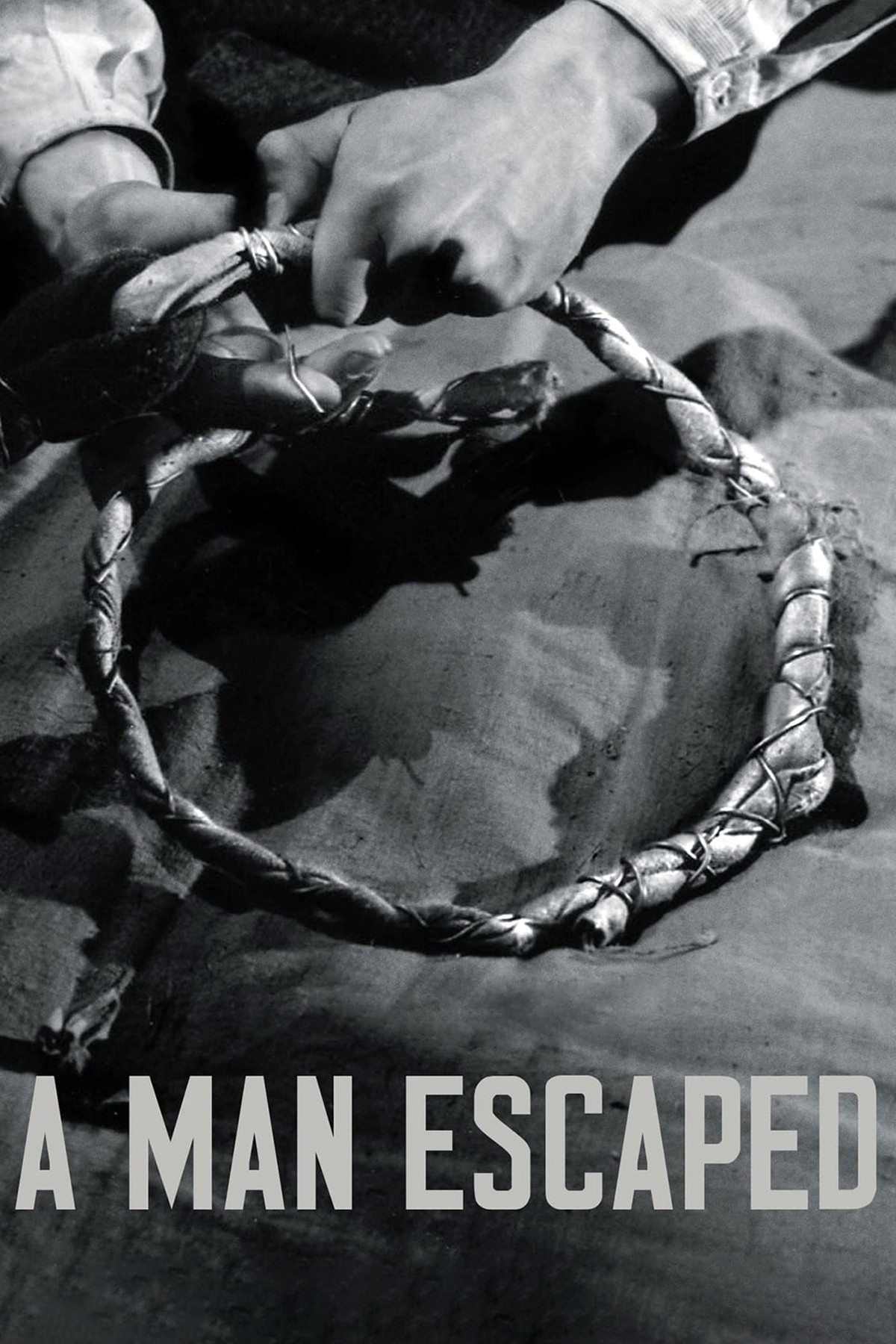
A Man Escaped is imbued with the anxieties and aspirations of its historical moment. The film, based on the true story of André Devigny, a French Resistance fighter imprisoned by the Nazis, foregrounds not just the drama of escape but the psychological, ethical, and spiritual journey of its protagonist. This focus closely mirrors the existential questions facing postwar French society.
The film’s ascetic style—stripped of melodrama, reliant on minute gestures, and marked by Bresson’s signature use of nonprofessional actors—speaks to a desire for authenticity over artifice. This was a deliberate repudiation of both propaganda and distraction, reflecting a society that had grown weary of grandiose tales and instead hungered for truth, however stark. The methodical depiction of the escape plan, the careful attention to materials, routines, and sounds, reflects not only the deprivation and discipline of prison life but also a metaphorical journey toward self-liberation—a theme central to national recovery in postwar France.
The omnipresent threat of betrayal and the uncertainty as to whom to trust within the prison setting echo the fractured loyalties of Occupied France. The protagonist, Fontaine, is forced to weigh the risks and consequences of trust—a process loaded with significance for contemporary French audiences who remembered the danger of informants and collaborators.
Perhaps most tellingly, A Man Escaped situates the act of resistance not in grand battlefields but within the lonely perseverance of an individual. The decision to resist, endure, and ultimately escape becomes emblematic of both collective memory and individual conscience—arguably the same tension playing out in the public consciousness as France reckoned with its wartime past and ongoing questions of authority.
Bresson’s narrative never resorts to overt polemic; instead, it offers a restrained meditation on the possibility of freedom, the demands of hope, and the necessity of faith—even, perhaps especially, in the face of overwhelming adversity. These themes, so closely aligned with the existential mood of the 1950s, underscore the film’s resonance as both a work of art and a historical document.
Changing Perceptions Over Time
While A Man Escaped was received with considerable acclaim upon its release, its status and interpretation have undergone significant transformation in the decades since. Initially, its stark realism and spiritual undercurrents appealed primarily to critics and cinephiles, some of whom recognized in it a touchstone for postwar moral inquiry. For others, the film’s austerity challenged traditional expectations of cinematic storytelling—its lack of sentimentality and slow, deliberate pace required audiences to adjust their rhythm and expectations.
By the late twentieth century, as the French New Wave had revolutionized global cinema and existentialism gave way to postmodern currents, the film’s themes began to be read less as direct reflections on recent wartime experience and more as allegories for the human condition. The concrete context of Nazi occupation receded in the popular imagination, making way for more universal interpretations: the metaphor of the prison representing all forms of oppression, alienation, or spiritual longing.
In the new millennium, critics and scholars have returned to examine A Man Escaped not just as a touchstone of postwar French cinema, but as an exemplar of a unique moment in European history—when personal integrity, radical hope, and skeptical realism converged. Younger generations, often viewing the Second World War at a greater remove, have more readily situated the film within discussions about surveillance, resistance to authority, and the problem of moral action in constrained circumstances.
At the same time, the film has come to be regarded as a landmark in cinematic technique. Its minimalist aesthetic and use of nonprofessional actors are now seen as precursors to later developments in world cinema, including the Italian Neorealists and even aspects of independent film across the globe. Thus, the conditions and concerns of 1950s France, once so specific, have gained a kind of universality, allowing A Man Escaped to function as both a period piece and an ever-renewing commentary on the struggle for freedom in any time.
Historical Takeaway
A Man Escaped stands as a testament to the complexity and introspection that defined the immediate postwar era in France. Through its measured narrative and rigorous formal discipline, the film challenges viewers to recognize the profound effect of historical context on individual choice, community, and conscience. It does not simply portray the events of a war-torn moment but meditates on what it means to resist—not just an external oppressor, but despair, inertia, and complicity.
The film’s refusal to distill its characters into archetypes speaks to the uncertainty that suffused French society in the 1950s. It invites audiences to grapple with the difficult realities of survival and resistance, to question the nature of freedom, and to value hope as an act of willful creation rather than passive expectation. Its significance lies not only in its recounting of one man’s escape but in its illumination of the philosophical and moral questions that haunted a generation.
Ultimately, A Man Escaped reveals a time when France—and much of Europe—strove to find meaning in suffering, dignity in struggle, and unity in the midst of real division. It demonstrates how art can become both witness and participant in the process of national, and profoundly personal, reckoning. For anyone seeking to understand the burden and the possibility of postwar European life, Bresson’s film remains a quietly powerful guide.
🎬 Check out today's best-selling movies on Amazon!
View Deals on Amazon