
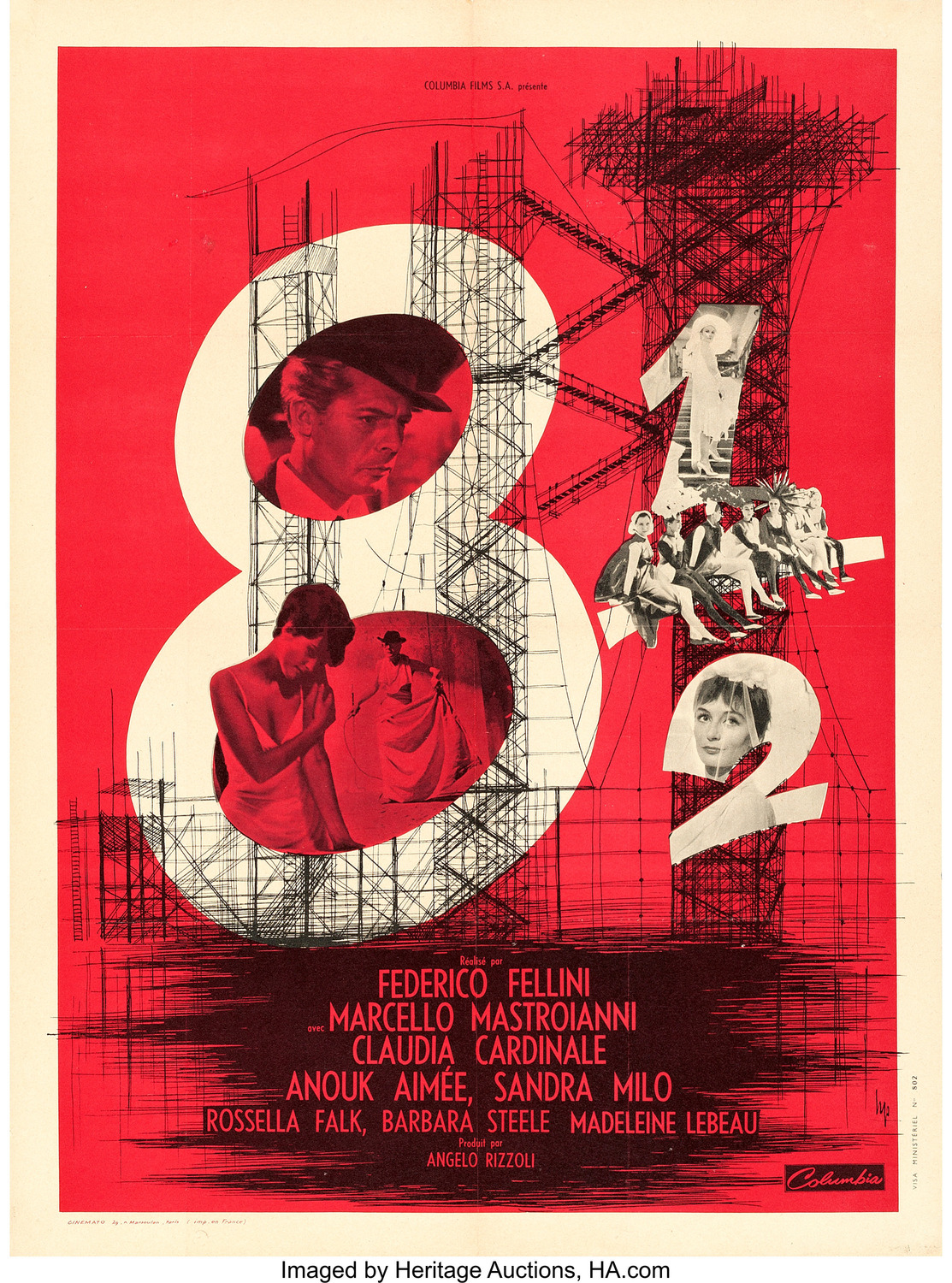
The Historical Landscape
To understand the profound resonance of Federico Fellini’s 8½, released in 1963, one must situate it within the shifting terrain of postwar Europe, and more specifically, Italy in the early 1960s. Two decades had passed since the end of World War II, and the Italian peninsula was in the midst of a remarkable metamorphosis. By 1963, Italy was experiencing a period often termed the “Italian economic miracle” (Il Miracolo Economico)—a decade-long explosion of industrial growth, technological advancement, and modernization that drastically reconfigured urban landscapes and widened consumer access to cars, appliances, and modern leisure. Traditional social structures, anchored in family, Catholicism, and rural customs, were rapidly being supplanted by urbanization and secularization. Rome, once a city of ancient ruins and ecclesiastical power, now hosted vibrant boulevards, cafes buzzing with intellectuals, fashion houses, and the dazzling chaos of the Italian film industry, Cinecittà.
The postwar trauma was still palpable beneath the surface, expressed through both an exuberant embrace of modernity and a lingering sense of spiritual void. Artistic circles were deeply preoccupied with existential questions: identity, creativity, and the malaise of affluence. Italian Neorealism, the stark cinematic movement that flourished in the late 1940s and early 1950s, had already crested, but its legacy shaped the very foundations upon which contemporary filmmakers built their works. The gravity of neorealist engagement with social hardship was giving way to more personal, abstract, and introspective forms. Directors such as Antonioni, Visconti, and of course, Fellini, were straddling the worlds of realism and imagination, blending the concrete with the dreamlike.
Across the wider world, the early 1960s were pregnant with contradictions. The Cold War fostered both anxiety and a yearning for liberation. The Second Vatican Council (1962–1965) suggested seismic shifts in the authority and openness of the Church. The young generation rebelled, seeking authenticity in the face of conventionality, experimenting with new forms of art, fashion, and morality. In such a turbulent era, 8½ emerges as a deeply modern film, capturing both the euphoria and the confusion that permeated not only Italy but much of the Western world in the early 1960s.
Cultural and Political Undercurrents
Beneath the surface optimism of modernization lay tensions that would deeply influence Italian art and society—and by extension, the cinema of Fellini. The economic miracle brought with it rampant consumerism and a culture increasingly obsessed with image, status, and novelty. Yet many Italians felt destabilized by the speed and direction of change: rising divorce rates, youth disillusionment, urban isolation, and the blurring of moral boundaries. The old world was slipping away, but its values still cast long, sometimes mournful shadows.
Culturally, this was both a moment of liberation and a catalyst for anxiety about meaning and authenticity. The Catholic Church, a defining pillar of Italian society, faced both internal reforms and external skepticism. The reforms of Vatican II reflected and reinforced a broader search for spiritual relevance, while intellectuals wrestled with secularism’s gains and losses. Politically, Italy was unstable. Despite economic strides, governments were fragile, and corruption, inefficiency, and ideological polarization (between Christian Democrats and the strong Communist left) colored public life. The specter of fascism remained uncomfortably recent.
Simultaneously, Italian cinema had achieved unprecedented international acclaim. Directors, emboldened by both critical recognition and a growing international audience, pushed the boundaries of narrative, style, and subject matter. Art was increasingly recognized as a vehicle for personal expression rather than merely social instruction. Fellini, who had moved from the neorealist tradition to more surreal and fantastical modes, typified this evolution. In 8½, the self-referential, fragmented style reflected not only his own autobiographical struggles, but also a broader collective experience: the disorientation of modernity.
The themes of alienation, identity crisis, and the search for meaning, which saturate 8½, echoed existential and psychoanalytic discourses flourishing in 1960s Europe. Influenced by contemporaries like Sartre and the rising popularity of Freudian and Jungian thought, artists delved into subjective consciousness. The creative process itself became suspect, fraught with doubt and blocked by external pressures—commercialism, critics, collaborators, and the ever-watchful public. Thus, 8½ was both a product and a probe of its cultural circumstances: a film in which the act of filmmaking becomes a metaphor for existential struggle.
The Film as a Reflection of Its Time
8½ is, on its surface, a tale of a film director, Guido Anselmi—Fellini’s alter ego—suffering a creative and personal crisis as he attempts to make a new movie. However, the film’s deeper structure is one of spiraling introspection and confusion, mirroring the uncertainties of the era. With its layered mixture of reality, memory, and fantasy, 8½ embodies the redefinition of narrative cinema prompted by Italy’s social and cultural transformations.
The film’s principal motif—the artist blocked—reflects not only Fellini’s own anxieties but also a broader crisis of identity among the intelligentsia. Amid economic prosperity, the creative class felt beset by questions of authenticity and meaning. Guido’s inability to reconcile his public demands (from producers, actors, journalists, lovers, and his estranged wife) with his private yearnings and confusions can be read as an allegory for Italy itself: a nation torn between the allure and emptiness of material progress, the pull of tradition, and the drift toward new, uncharted moral and artistic territory.
Moreover, 8½’s meta-cinematic qualities—the way it presents filmmaking as a chaotic, sometimes absurd, often paralyzing enterprise—mirrored the state of Italian cinema undergoing self-examination. Directors were coming to grips with their powers and limitations in a world increasingly dominated by commerce, celebrity, and fleeting novelty. The proliferation of images, the fluidity of truth, the commodification of dreams: these were not just aspects of Guido’s predicament, but widespread societal concerns. The film’s dream sequences, its non-linear structure, and its blend of melancholy and spectacle epitomized the experimental impulses animating European—and especially Italian—cinema in this period.
The visual language of 8½ is also steeped in the atmosphere of the 1960s, a decade when style and substance were entwined as never before. The sumptuous black-and-white cinematography, the surreal carnivalesque scenes, and the parade of beautiful women reflected both the new permissiveness and the persistent power of erotic fantasy in Italian life. The Church, represented through both ridicule and yearning, stood as a symbol of both lost innocence and ongoing inner struggle. In one memorable scene, Guido’s childhood recollection of bathing at the seashore is interrupted by priests who shame him—a vignette encapsulating the ongoing negotiation between tradition and personal freedom that gripped not only the filmmaker himself but his society as a whole.
Most strikingly, the fragmentation and confusion at the heart of 8½ capture the sense of an era on the cusp of transformation—an Italy still negotiating its place between the ancient and the modern, the sacred and the secular, the communal and the individual. The film offers no easy solutions, but, like the decade itself, delights in the questioning, in the embrace of uncertainty as a defining mode of existence.
Changing Perceptions Over Time
When 8½ premiered, it was received as both a critical triumph and a work that bewildered many audiences. Its radical structure—dreamlike, self-referential, at times bordering on the incomprehensible—broke with both neorealist conventions and the more linear narratives familiar to international viewers. For its contemporary audience, the film’s inward-turning focus on the struggles of a privileged artist struck some as solipsistic, while others saw it as an honest account of modern malaise. Over time, however, the film’s reputation grew, and it came to be seen not just as a meditation on the individual artist, but as a mirror of a society in flux, as relevant to the anxieties of modernity as to the confessions of its creator.
Interpreted initially as both a confessional and a postmodern puzzle, 8½ became a touchstone for filmmakers and critics grappling with the nature of cinema itself. In the decades following its release, as the language of film shifted toward ever more complex, reflexive, and ambiguous forms, 8½’s methods and themes were celebrated as prophetic. The breakdown between fantasy and reality anticipated the work of directors as diverse as Woody Allen, Bob Fosse, and Charlie Kaufman. In the late twentieth and early twenty-first centuries, as postmodernism reigned and questions of authorship, authenticity, and the permeable line between art and life became mainstream, 8½ came to seem ever more contemporary.
Younger generations of critics, influenced by gender studies and psychoanalytic approaches, have also revisited the film’s depictions of women, sexuality, and memory, airing new critiques as well as admiration. The “male gaze,” Guido’s objectification of women, and the film’s ambiguities toward both liberation and nostalgia, are now part of ongoing debates about its legacy. In Italy, especially, the film is now seen as both a breakthrough and a time capsule—a record of a moment when an artist’s private struggle captured the shifting dreams and fears of a changing nation.
Historical Takeaway
If there is a single lesson 8½ teaches about its era, it is that the 1960s were a time of astonishing, often bewildering transformation—and that both artists and ordinary people struggled to invent meaningful lives in the shadow of that change. The film’s mixture of playfulness and pain, its deep ambivalence about progress and nostalgia, its willingness to unravel certainty, all mark it as a creation of historical upheaval. What Fellini mapped in his cinematic labyrinth was not just the terrain of his own psyche, but the contours of a society losing its old coordinates, compelled to improvise new forms of art, love, faith, and self-understanding.
Through its depiction of creative paralysis and renewal, 8½ stands as both a product and a chronicle of a defining chapter in Italian—and Western—history. It records a world careening between wonder and despair, between spectacle and emptiness, much as Italy itself was poised between the memory of war and the promises and perils of modernity. By refusing to resolve its contradictions, Fellini’s masterpiece invites every new viewer to glimpse, in the flurry of images, music, and dreams, the exhilarating uncertainty that marked both its moment and our own. In the final reckoning, 8½ is not simply a film about filmmaking—it is a testimony to the historical experience of being lost in order to be found, at once deeply particular and magnificently universal.
🎬 Check out today's best-selling movies on Amazon!
View Deals on Amazon